A Software Factory on Kubernetes: Gemini Builds, jev Decides (Genkit + senro in Go) (English)
A feature request goes in; a designed, planned, implemented, tested and reviewed Go module comes out, or a brief for a human explaining why the factory stopped. Every stage is a Genkit flow running as a pod through senro, Gemini does the writing, and jev, a decision model, holds every gate: is the design ready, should the code ship, go back, or stop. A practical guide with a local kind cluster and every output pasted from a real run.
- Introduction
- Why a factory needs a judge, not a second writer
- What we are building
- What you need
- Step 1: a cluster and an image with a Go toolchain
- Step 2: the design loop, with jev inside the flow
- Step 3: plan, implement, and let Go have its say
- Step 4: the code review gate
- Step 5: three pipelines and a state machine
- Step 6: run it
- Step 7: when jev says no
- What the combination gives you
- Conclusion
Introduction
The previous article put Genkit flows in Kubernetes pods with senro and let jev, a decision model, route a support ticket. The decisions there were small: which team, how urgent, send or hold.
This one hands jev something bigger to judge: software. A software factory takes a feature request and produces a Go module: a design, a plan, the code, a green build, passing tests and a pull request description. Gemini writes every one of those. jev decides, at every gate, whether the work moves on, goes back, or stops for a human. Each stage runs as a pod, each stage is a Genkit flow, and the whole thing is a few hundred lines of Go.
Everything below ran against the real Gemini API (gemini-3.8-flash) and the real TypeSafe API (jev-latest), on Genkit Go v1.14.0, senro v1.4.5 and a local kind cluster. The code is in genkit-k8s-flows-jev-software-factory.
Why a factory needs a judge, not a second writer
The usual way to review model-written code is to ask another chat model. It works, up to a point. The reviewer writes a paragraph, you parse the paragraph, the paragraph is sometimes wrong in the same way the code is, and a well-written pull request description can talk the reviewer into “looks good to me”.
A decision model does not write. It takes a state (the request, the plan, the code, the test log) and answers typed questions with probabilities, in a few hundred milliseconds. There is no prose to parse and nothing to be talked into: BuildGreen is a number, and a red test log drags it down whatever the pull request says.
| Chat model as reviewer | Decision model as reviewer | |
|---|---|---|
| Verdict | A paragraph you parse | Choice[CodeVerdict]: ship, rework or human, with a probability each |
| Evidence | Mentioned, maybe | A Noul per question: covers the request, tests are meaningful, build is green |
| Feedback for the next round | Whatever it felt like writing | Each question that scored “yes” is one line of feedback |
| Latency and cost | Seconds, thousands of output tokens | Milliseconds, tokens for the state only |
| Can be persuaded by the author | Yes | No: it never reads instructions, only state |
The split that falls out of this is the whole design: Gemini builds, jev decides. And senro is what gives each build step a pod, a workspace, a log, a retry policy and a secret, and each decision a place in the graph.
What we are building
A feature request goes in. A reviewed Go module comes out, or a brief for a human saying why not.
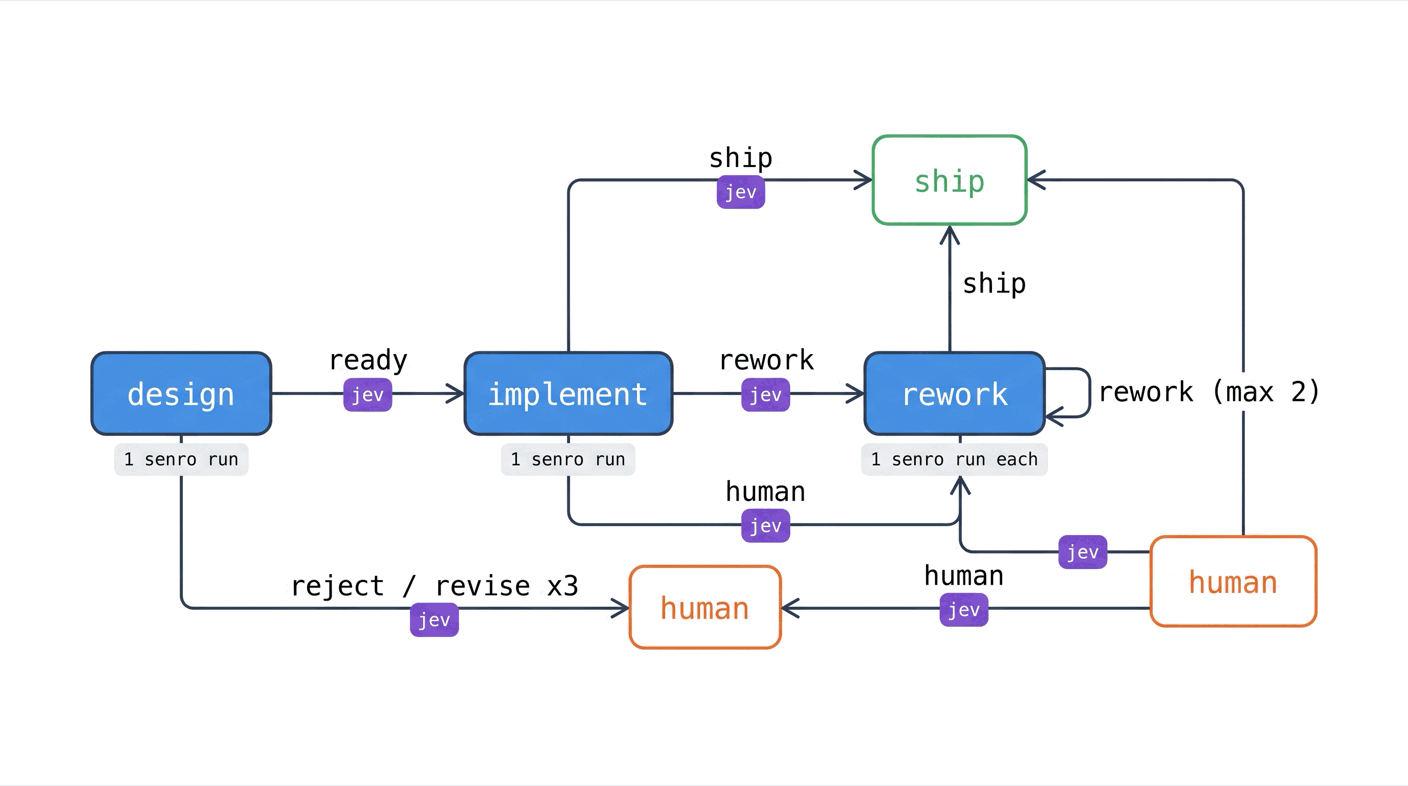
The factory is three senro pipelines and a small state machine over them:
| Run | Step | Where | Who | What it leaves behind |
|---|---|---|---|---|
design | clean | coordinator | none | an empty workspace with request.md in it |
design | design | pod | Gemini and jev, in a loop | design.json, DESIGN.md and one record per review round |
design | plan | pod | Gemini | plan.json, PLAN.md |
implement | implement | pod | Gemini | the module’s files |
implement | vet, test | pod | go vet, go test | vet.log, test.log and their exit codes |
implement | review | pod | jev | review.json: ship, rework or human |
rework | fix, then vet, test, review | pod | Gemini, Go, jev | the same, after a fix |
finish | pr then publish | pod, coordinator | Gemini | PR.md and the module under out/<request>/src |
finish | brief then notify | pod, coordinator | Gemini | BRIEF.md for a human |
jev decides three times. Inside the design step, it reviews each design Gemini writes and the loop revises until jev says ready, says reject, or three rounds are up. After test, it reviews the code with the logs in hand and picks ship, rework or human. And the state machine in main turns each verdict into the next senro run, with rework bounded at two.
What you need
- Go 1.27 or newer, Docker, kind and
kubectl GEMINI_API_KEYandTYPESAFE_API_KEYin your environment- the senro CLI if you want the terminal UI (optional)
go get github.com/firebase/genkit/go@v1.14.0
go get github.com/xavidop/senro@v1.4.5
go get github.com/xavidop/mamori
Step 1: a cluster and an image with a Go toolchain
The cluster setup is the one from the previous article: kind, a namespace, a ServiceAccount with the permissions senro’s Kubernetes executor needs (including get on pods/exec), and three environment variables, since senro never reads your kubeconfig. The repo’s scripts/cluster-up.sh does it and source scripts/cluster-env.sh exports them.
The one difference is the image. A func step needs only sh and tar in the pod, but this factory also runs go vet and go test as plain command steps, so every step uses the official Go image, pinned to its digest as senro requires:
const stepImage = "docker.io/library/golang:1.27-alpine@sha256:f2c872bcee949b7be9c490efd02b48a8a2fbf947cdf533f1c58525ec9d8170fd"

func pods() senro.ExecutorTarget {
	return k8s.Pod(stepImage,
		k8s.Namespace("factory"),
		k8s.Resources(
			map[string]string{"cpu": "500m", "memory": "512Mi"},
			map[string]string{"cpu": "2", "memory": "2Gi"},
		))
}
Your pipeline binary is still not in that image. senro cross-compiles it and sends it into each pod, exactly as before.
Step 2: the design loop, with jev inside the flow
The first gate is the one that saves the most money: a bad design produces bad code, a green build and a confident pull request. So the design is reviewed before anything is planned, and the review is a loop inside one Genkit flow.
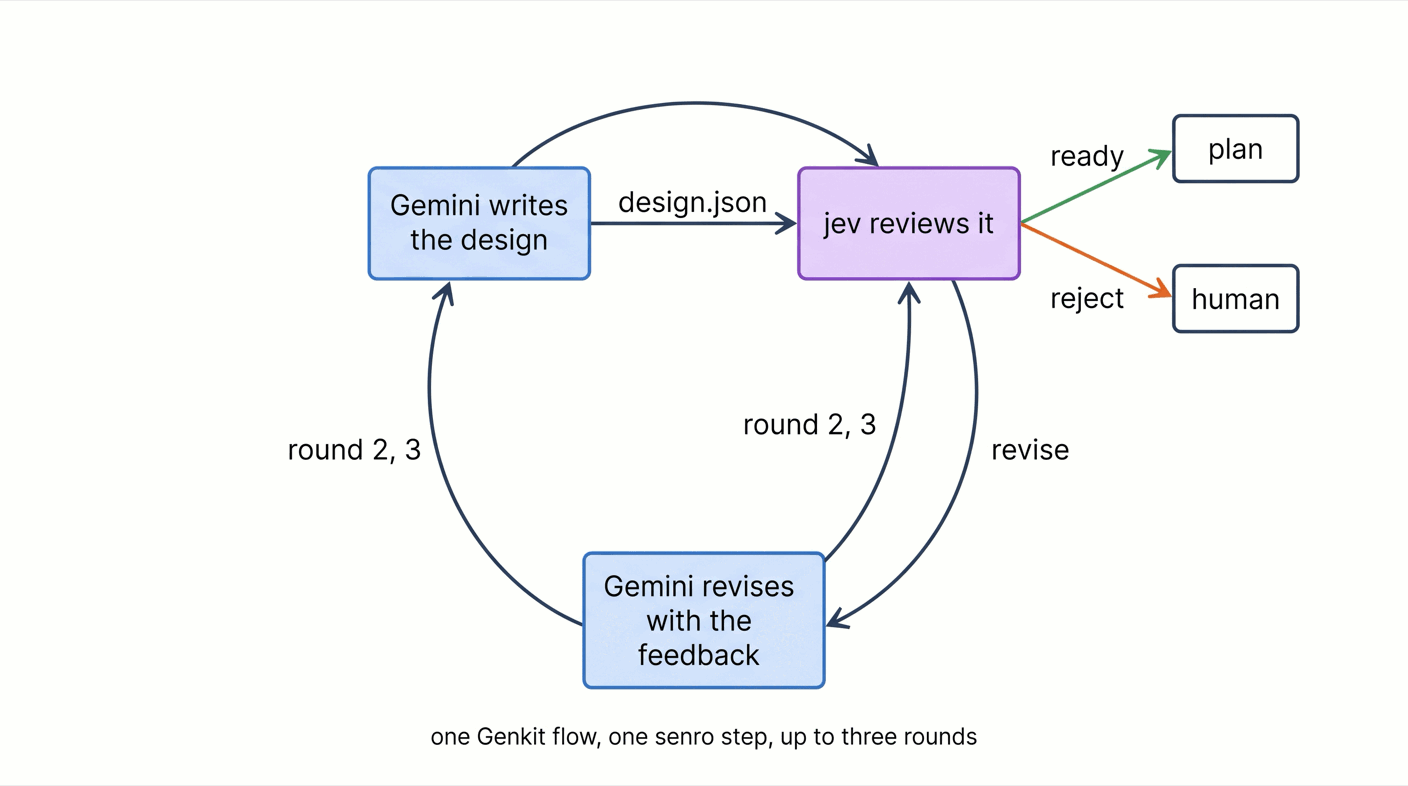
The questions are a Go type. Every yes/no question is one a revision can act on: a “yes” becomes a line of feedback for the next round.
type DesignVerdict string

func (DesignVerdict) Criteria() map[DesignVerdict]string {
	return map[DesignVerdict]string{
		"ready":  "Complete, unambiguous, scoped to the request, and testable as described",
		"revise": "The right direction, with gaps a revision can close",
		"reject": "The request is too vague or too large to design from; a human has to clarify it first",
	}
}

type Risk int

func (Risk) Levels() []string { return []string{"Low", "Medium", "High"} }

type DesignReview struct {
	Verdict        systemonex.Choice[DesignVerdict] `json:"verdict" jsonschema_description:"Is this design ready to implement?"`
	RequestClear   systemonex.Noul                  `json:"request_clear" jsonschema_description:"Does the request say what to build precisely enough that two engineers would build the same thing?"`
	ScopeCreep     systemonex.Noul                  `json:"scope_creep" jsonschema_description:"Does the design add things the request did not ask for?"`
	Underspecified systemonex.Noul                  `json:"underspecified" jsonschema_description:"Is any component described too loosely to implement without guessing: missing fields, signatures, edge cases or error behaviour?"`
	MissingTests   systemonex.Noul                  `json:"missing_tests" jsonschema_description:"Does the test plan leave any requirement of the request untested?"`
	Risk           systemonex.Score[Risk]           `json:"risk" jsonschema_description:"How risky is implementing this design as written?"`
}
And the loop. Gemini designs; jev reviews; if the verdict is revise, Gemini gets the previous design plus the feedback and tries again:
f.Design = genkit.DefineFlow(g, "designFeature", func(ctx context.Context, request string) (DesignResult, error) {
	var res DesignResult
	feedback := ""
	for round := 1; round <= maxDesignRounds; round++ {
		prompt := "Request:\n" + request
		if round > 1 {
			prompt += "\n\nYour previous design:\n" + asJSON(res.Design) + "\n\nReviewer feedback:\n" + feedback
		}
		d, _, err := genkit.GenerateData[Design](ctx, g,
			ai.WithModelName("googleai/gemini-3.8-flash"),
			ai.WithSystem("You are a senior Go engineer writing a short design for exactly what the request asks. "+
				"Stay inside the request: no extra features. Components are the Go types and functions you will create. "+
				"The test plan names concrete, deterministic test cases. Be brief."),
			ai.WithPrompt("%s", prompt))
		if err != nil {
			return res, err
		}
		res.Design = *d

		out, resp, err := genkit.GenerateData[DesignReview](ctx, g,
			ai.WithModelName("typesafe/jev-latest"),
			ai.WithSystem("The state has a feature request and a design written for it."),
			ai.WithPromptParts(ai.NewDataPart(map[string]any{"request": request, "design": res.Design})))
		if err != nil {
			return res, err
		}

		// jev's verdict, then our rules on top.
		verdict := string(out.Verdict.Choice)
		var notes []string
		if out.RequestClear.Probability < 0.4 {
			verdict = "reject" // nobody should design from a request two engineers would read differently
		}
		if out.ScopeCreep.Probability >= 0.5 {
			notes = append(notes, "remove everything the request did not ask for")
		}
		if out.Underspecified.Probability >= 0.5 {
			notes = append(notes, "specify every component fully: fields, signatures, edge cases and error behaviour")
		}
		if out.MissingTests.Probability >= 0.5 {
			notes = append(notes, "add a test case for every requirement in the request")
		}
		if verdict == "ready" && len(notes) > 0 {
			verdict = "revise"
		}
		res.Rounds = append(res.Rounds, DesignRound{Round: round, Verdict: verdict,
			Ready: out.Verdict.Probabilities["ready"], Feedback: notes /* ... */})
		res.Verdict = verdict
		if verdict != "revise" {
			break
		}
		feedback = fmt.Sprintf("The reviewer rated the design %q (probability of ready %.2f). Do the following:\n- %s",
			verdict, out.Verdict.Probabilities["ready"], strings.Join(notes, "\n- "))
	}
	return res, nil
})
Two things to notice. The verdict is jev’s, but the rules around it are yours: a request that two engineers would read differently is rejected whatever the design looks like, and a design with a flagged problem is not ready even if jev leaned that way. And the feedback is built from the questions, not from prose: a decision model never writes a sentence, so the sentences live in your code, one per question, and the next round gets exactly the ones that applied.
The whole loop is one flow, so it is one senro step, one pod, one log, with every round recorded in design.json.
Step 3: plan, implement, and let Go have its say
The plan and the implementation are ordinary Gemini calls with typed outputs: a Plan with files and steps, then a Code with every file in full. The step writes the files into the workspace, refusing anything that would escape it:
type Code struct {
	Files []File `json:"files"`
	Notes string `json:"notes,omitempty"`
}

func writeCode(ctx senro.Ctx, code Code) error {
	root := wsPath(ctx, ".")
	for _, f := range code.Files {
		rel := filepath.Clean(f.Path)
		if rel == "." || strings.HasPrefix(rel, "..") || filepath.IsAbs(rel) || strings.HasPrefix(rel, factoryDir) {
			return fmt.Errorf("refusing to write outside the module: %q", f.Path)
		}
		path := filepath.Join(root, rel)
		if err := os.MkdirAll(filepath.Dir(path), 0o755); err != nil {
			return err
		}
		if err := os.WriteFile(path, []byte(f.Content), 0o644); err != nil {
			return err
		}
		fmt.Fprintf(ctx.Stdout(), "wrote %s (%d bytes)\n", rel, len(f.Content))
	}
	return nil
}
Then the compiler and the tests run, as command steps in the same pod image, with no model anywhere near them:
func goStep(w *senro.WorkflowBuilder, id, after, cmd string, ws *senro.WorkspaceRef) *senro.StepBuilder {
	script := "mkdir -p .factory; " + cmd + " > .factory/" + id + ".log 2>&1; echo $? > .factory/" + id + ".exit; " +
		"cat .factory/" + id + ".log; exit $(cat .factory/" + id + ".exit)"
	return w.Step(id, exec.Command("sh", "-c", script)).
		Needs(after).
		Mount(ws.At("/repo", senro.RW)).
		WorkDir("/repo").
		Env("HOME", "/tmp").
		Env("GOCACHE", "/tmp/gocache").
		Env("GOFLAGS", "-mod=mod").
		Env("GOPROXY", "off").
		Env("GOTOOLCHAIN", "local").
		Env("CGO_ENABLED", "0").
		Timeout(stepTimeout).
		Retry(3, retry.OnInfra()).
		ContinueOnError()
}

goStep(code, "vet", "implement", "go vet ./...", ws)
goStep(code, "test", "vet", "go test -count=1 ./...", ws)
Each one leaves its output and exit code under .factory/ in the workspace, so the reviewer can read them. GOPROXY=off and GOTOOLCHAIN=local keep the pod honest: the request said standard library only, and the pod cannot download anything to pretend otherwise. And ContinueOnError is the important one: a red test is a failed step, but the review still runs. jev gets to see why the build failed, which is exactly the evidence a rework needs.
Step 4: the code review gate
The second gate reads everything a human reviewer would open: the request, the plan, every source file, and what go vet and go test printed.
type CodeVerdict string

func (CodeVerdict) Criteria() map[CodeVerdict]string {
	return map[CodeVerdict]string{
		"ship":   "Builds, tests pass, does what the request asked, no obvious defects",
		"rework": "Fixable problems: failing or missing tests, a missed requirement, sloppy code",
		"human":  "Something a model should not decide: security, data loss, or the request was misunderstood",
	}
}

type Quality int

func (Quality) Levels() []string { return []string{"Poor", "Acceptable", "Good", "Excellent"} }

type CodeReview struct {
	Verdict         systemonex.Choice[CodeVerdict] `json:"verdict" jsonschema_description:"Should this change ship?"`
	Quality         systemonex.Score[Quality]      `json:"quality" jsonschema_description:"How good is the code?"`
	CoversRequest   systemonex.Noul                `json:"covers_request" jsonschema_description:"Does the implementation do everything the request asked for?"`
	TestsMeaningful systemonex.Noul                `json:"tests_meaningful" jsonschema_description:"Do the tests exercise the behaviour the request cares about, rather than just compile?"`
	BuildGreen      systemonex.Noul                `json:"build_green" jsonschema_description:"According to the logs and exit codes, did go vet and go test both pass?"`
}
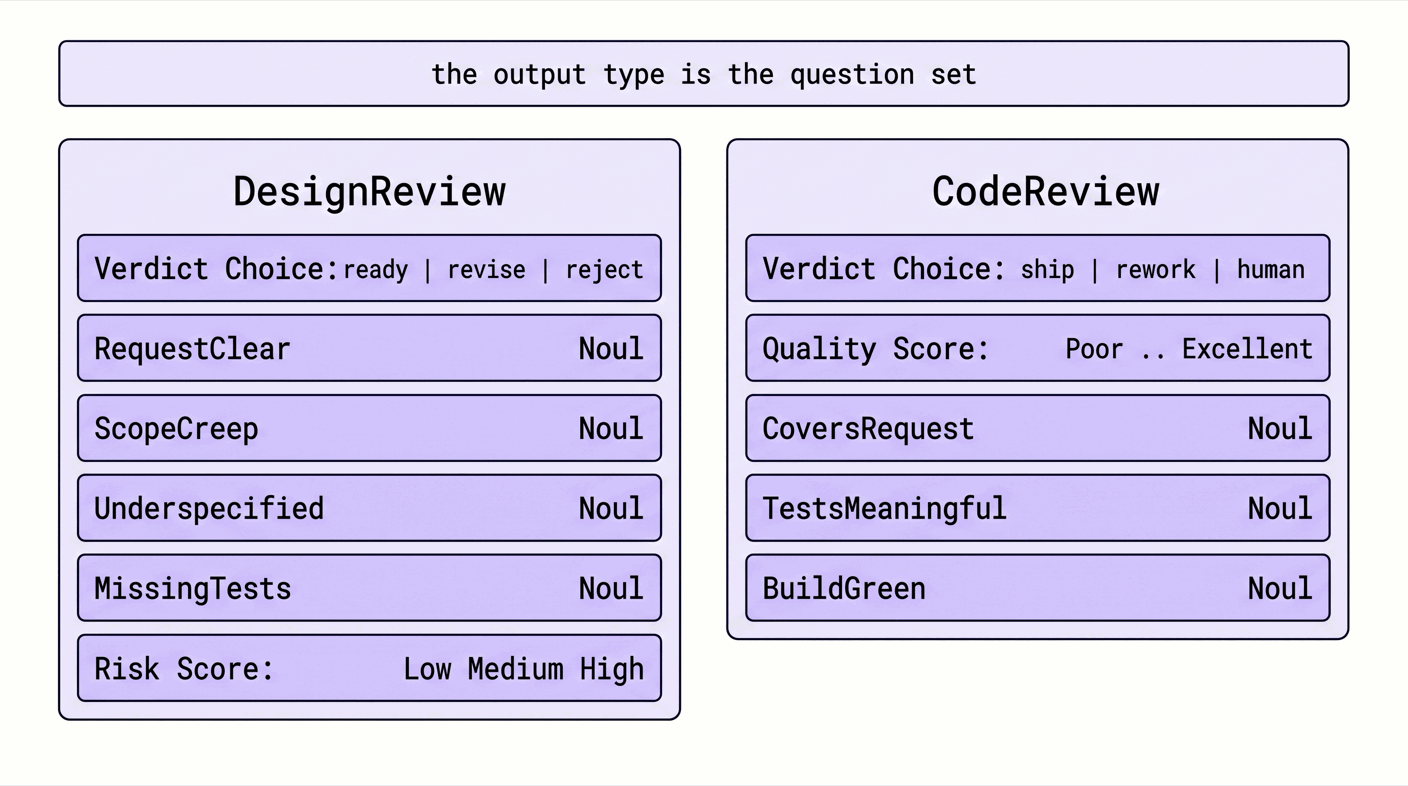
The flow sends the whole ReviewInput as a data part, reads the answers, and applies the factory’s rules on top. A red build never ships, whatever the overall verdict:
f.Review = genkit.DefineFlow(g, "reviewChange", func(ctx context.Context, in ReviewInput) (Review, error) {
	out, resp, err := genkit.GenerateData[CodeReview](ctx, g,
		ai.WithModelName("typesafe/jev-latest"),
		ai.WithSystem("The state has the feature request, the implementation plan, every source file, "+
			"and the output and exit codes of go vet and go test. Exit code 0 means success."),
		ai.WithPromptParts(ai.NewDataPart(in)))
	if err != nil {
		return Review{}, err
	}
	r := Review{
		Verdict:         string(out.Verdict.Choice),
		Confidence:      out.Verdict.Confidence,
		Quality:         out.Quality.Label(),
		CoversRequest:   out.CoversRequest.Probability,
		TestsMeaningful: out.TestsMeaningful.Probability,
		BuildGreen:      out.BuildGreen.Probability,
		Model:           systemonex.ResponseInfo(resp).Model,
	}
	if in.VetExit != 0 {
		r.Reasons = append(r.Reasons, "go vet failed")
	}
	if in.TestExit != 0 {
		r.Reasons = append(r.Reasons, "go test failed")
	}
	if r.CoversRequest < 0.6 {
		r.Reasons = append(r.Reasons, "the implementation does not cover the request")
	}
	if r.TestsMeaningful < 0.5 {
		r.Reasons = append(r.Reasons, "the tests do not exercise the requested behaviour")
	}
	if out.Quality.Level() == 0 {
		r.Reasons = append(r.Reasons, "code quality is poor")
	}
	if r.Verdict == "ship" && len(r.Reasons) > 0 {
		r.Verdict = "rework"
	}
	return r, nil
})
The Reasons are what the fix flow gets, together with the logs. Again: the decision model decides, your code says it in words.
Step 5: three pipelines and a state machine
The module under construction lives in a persistent workspace, so every run of one request works on the same tree. senro insists a persistent workspace is bounded, and refuses one without both bounds:
func repo() *senro.WorkspaceRef {
	return senro.Workspace("factory-repo",
		senro.Scope(senro.ScopePersistent),
		senro.MaxAge(24*time.Hour),
		senro.MaxSize(256<<20))
}
The three pipelines are short. Every AI step gets the same shape through a helper, with only the secrets it needs:
func aiStep(s *senro.StepBuilder, ws *senro.WorkspaceRef, secrets ...string) *senro.StepBuilder {
	s = s.Mount(ws.At("/repo", senro.RW)).Timeout(stepTimeout).Retry(3, retry.OnInfra())
	for _, name := range secrets {
		s = s.SecretEnv("SENRO_"+name, name)
	}
	return s
}

func buildPipeline(outDir string, rework bool) *senro.Pipeline {
	name, fn := "implement", "factory/implement"
	if rework {
		name, fn = "rework", "factory/fix"
	}
	p := senro.New(name)
	ws := repo()

	code := p.Workflow("code", senro.On(pods()))
	aiStep(code.Step(name, senro.Func(fn, NoParams{})), ws, "Gemini")
	goStep(code, "vet", name, "go vet ./...", ws)
	goStep(code, "test", "vet", "go test -count=1 ./...", ws)
	aiStep(code.Step("review", senro.Func("factory/review", NoParams{})), ws, "TypeSafe").Needs("test")

	handoff := p.Workflow("handoff", senro.Needs("code"), senro.On(senro.Local()))
	handoff.Step("collect", senro.Func("factory/collect", DirParams{Dir: outDir})).
		Mount(ws.At("/repo", senro.RO))

	return p
}
finish declares both endings and lets a run parameter pick one, the same senro.When pattern as the previous article:
func finishPipeline(outDir, reason string) *senro.Pipeline {
	p := senro.New("finish")
	ws := repo()

	ship := p.Workflow("ship", senro.On(pods()), senro.When(senro.ParamIs("verdict", "ship")))
	aiStep(ship.Step("pr", senro.Func("factory/pr", NoParams{})), ws, "Gemini")

	publish := p.Workflow("publish", senro.Needs("ship"), senro.On(senro.Local()),
		senro.When(senro.ParamIs("verdict", "ship")))
	publish.Step("publish", senro.Func("factory/publish", DirParams{Dir: outDir})).
		Mount(ws.At("/repo", senro.RO))

	escalate := p.Workflow("escalate", senro.On(pods()), senro.When(senro.ParamIs("verdict", "human")))
	aiStep(escalate.Step("brief", senro.Func("factory/brief", BriefParams{Reason: reason})), ws, "Gemini")
	// ...and a notify workflow on the coordinator that collects BRIEF.md
	return p
}
And main is the state machine. Each run ends with a record jev produced, and the record picks the next run:
state, reason, reworks := "design", "", 0
for {
	switch state {
	case "design":
		if err := run(designPipeline(request, out)); err != nil {
			exit(err)
		}
		var d DesignResult
		read(out, "design.json", &d)
		if d.Verdict == "ready" {
			state = "implement"
		} else {
			state, reason = "human", fmt.Sprintf("the design review ended %q after %d round(s)", d.Verdict, len(d.Rounds))
		}

	case "implement", "rework":
		// A red vet or test is a failed step, so the run is partial; the
		// review still ran (ContinueOnError) and its verdict is what counts.
		if err := run(buildPipeline(out, state == "rework")); err != nil && !partial(err) {
			exit(err)
		}
		var r Review
		read(out, "review.json", &r)
		switch r.Verdict {
		case "ship":
			state = "ship"
		case "rework":
			if reworks >= *maxRework {
				state, reason = "human", fmt.Sprintf("jev asked for rework %d times: %v", reworks+1, r.Reasons)
			} else {
				reworks++
				state = "rework"
			}
		default:
			state, reason = "human", fmt.Sprintf("the code review ended %q: %v", r.Verdict, r.Reasons)
		}

	case "ship", "human":
		if err := run(finishPipeline(out, reason), senro.WithParams(senro.Params{"verdict": state})); err != nil {
			exit(err)
		}
		return
	}
}
Every arrow in the state diagram is one of those cases, and every run is a directory under runs/ with its plan, its events and one log per step.
Step 6: run it
The first request is a token-bucket rate limiter, the kind of package every service ends up with:
# Feature request: a token-bucket rate limiter package

We need a small, dependency-free Go package `ratelimit` (module path
`github.com/acme/ratelimit`) that other services can import.

- `New(rate float64, burst int) *Limiter`: `rate` is tokens added per second,
  `burst` is the bucket capacity.
- `(*Limiter) Allow() bool`: takes one token if available, otherwise returns false
  without blocking.
- `(*Limiter) AllowN(n int) bool` for batches.
- Safe for concurrent use from many goroutines.
- Time must be injectable so tests are deterministic (no sleeping in tests).
- Standard library only. Tests included, run with `go test ./...`.
go run . -request requests/token-bucket.md
The first run is the design. Read back with senro attach --run <id> --ui=plain:
clean succeeded
design stdout | round 1: jev-1.13.0 decided "revise" (p_ready 0.44) request_clear=0.62 scope_creep=0.36 underspecified=0.56 missing_tests=0.38 risk=Low
design stdout |   - specify every component fully: fields, signatures, edge cases and error behaviour
design stdout | round 2: jev-1.13.0 decided "ready" (p_ready 0.57) request_clear=0.57 scope_creep=0.49 underspecified=0.28 missing_tests=0.34 risk=Low
design succeeded
plan stdout | module github.com/acme/ratelimit, 3 files, 11 steps
plan succeeded
collect succeeded
run succeeded
Two rounds. jev found the first design underspecified (0.56), the feedback said so in one sentence, and the second design named every field, signature and edge case. The ready probability moved from 0.44 to 0.57, and the design that came out of it is the one Gemini implemented; this is its component list in DESIGN.md:
## Components

- type Limiter struct { mu sync.Mutex; rate float64; burst float64; tokens float64;
  last time.Time; now func() time.Time } - concurrency-safe state tracking ...
- func New(rate float64, burst int) *Limiter - public constructor delegating to
  newWithClock using time.Now; clamps negative rate to 0.0 and negative burst to 0 ...
- func newWithClock(rate float64, burst int, now func() time.Time) *Limiter - internal
  constructor enabling time injection for tests; ... panics if now is nil.
- func (l *Limiter) Allow() bool - convenience method returning l.AllowN(1) ...
- func (l *Limiter) AllowN(n int) bool - thread-safe token deduction; edge cases: returns
  true immediately if n <= 0 without modifying state; returns false immediately if
  n > int(l.burst); advances tokens by elapsed.Seconds() * l.rate capped at l.burst ...
The plan turns that into three files and eleven steps, and the second run executes it.
implement stdout | wrote go.mod (42 bytes)
implement stdout | wrote ratelimit.go (1371 bytes)
implement stdout | wrote ratelimit_test.go (3172 bytes)
implement succeeded
vet succeeded
test stdout | ok  	github.com/acme/ratelimit	0.009s
test succeeded
review stdout | jev-1.13.0 decided "ship" (confidence 0.66) quality=Excellent covers_request=0.87 tests_meaningful=0.95 build_green=0.98
review succeeded
collect succeeded
run succeeded
Gemini wrote the module, go vet and go test ran in the pod against it, and jev read the three files and the logs and said ship, with the build at 0.98 and the tests at 0.95. The module it reviewed:
// AllowN reports whether n tokens can be consumed immediately.
func (l *Limiter) AllowN(n int) bool {
	l.mu.Lock()
	defer l.mu.Unlock()

	if n <= 0 {
		return true
	}
	if float64(n) > l.burst {
		return false
	}

	curr := l.now()
	elapsed := curr.Sub(l.last)
	if elapsed > 0 {
		l.tokens += elapsed.Seconds() * l.rate
		if l.tokens > l.burst {
			l.tokens = l.burst
		}
		l.last = curr
	}

	if l.tokens >= float64(n) {
		l.tokens -= float64(n)
		return true
	}
	return false
}
with six tests beside it: clamping, a nil clock panic, burst capacity, AllowN edge cases, deterministic replenishment against an injected clock, and a race test over concurrent goroutines. No sleeping anywhere, as the request demanded.
The third run has both endings declared and runs one:
pr stdout | # Implement token-bucket rate limiter package
pr stdout | ## Summary
pr stdout | Introduces `github.com/acme/ratelimit`, a thread-safe, zero-dependency token-bucket rate limiter. ...
pr stdout | ## Tests
pr stdout | ok  	github.com/acme/ratelimit	0.009s
pr stdout | ## Risk
pr stdout | Low. Mutex contention under high concurrency is mitigated by keeping critical sections limited to basic in-memory arithmetic. ...
pr succeeded
publish stdout | published 3 files to .../out/token-bucket/src
publish succeeded
brief skipped_condition
notify skipped_condition
run succeeded
Three senro runs, seven pods, two Gemini designs, two jev design reviews, one implementation, one vet, one test, one jev code review and one pull request, in a little over a minute and a half. out/token-bucket/ holds every record and the module under src/.
Step 7: when jev says no
The second request is the kind every team gets:
# Request

The app feels slow lately, especially in the afternoon. Can you make it faster?
Nothing specific, just whatever you think is best. Thanks.
go run . -request requests/make-it-faster.md
clean succeeded
design stdout | round 1: jev-1.13.0 decided "reject" (p_ready 0.13) request_clear=0.05 scope_creep=0.87 underspecified=0.70 missing_tests=0.79 risk=Low
design stdout |   - remove everything the request did not ask for
design stdout |   - specify every component fully: fields, signatures, edge cases and error behaviour
design stdout |   - add a test case for every requirement in the request
design succeeded
plan stdout | design ended "reject", nothing to plan
plan succeeded
collect succeeded
run succeeded
Gemini did what a chat model does with a vague request: it invented a feature, in this case pprof routes and a latency middleware. jev put the probability that the request is clear at 0.05, and the factory’s rule turned that into reject in the first round, before a plan, a line of code or a second model call. The finish run then takes the other ending:
pr skipped_condition
publish skipped_condition
brief stdout | ### What was asked
brief stdout | A user submitted a vague performance complaint stating the app "feels slow lately, especially in the afternoon" and asked to "make it faster" without providing specific endpoints, metrics, or reproduction steps.
brief stdout | ### Why it stopped
brief stdout | The design was rejected on Round 1 (Readiness: 13%, Clarity: 5%). The factory attempted to introduce Go `net/http/pprof` diagnostic routes and custom in-memory latency middleware, triggering a rejection for high scope creep (87%) ...
brief stdout | ### What a human should decide
brief stdout | 1. **Clarify the issue:** Contact the user to identify affected routes, user workflows, and target latency SLOs.
brief stdout | 2. **Authorize observability work:** Determine if the team should prioritize a dedicated ticket for production profiling/metrics ...
brief succeeded
notify succeeded
run succeeded
The brief is written by Gemini, from the record jev produced. The two models keep their jobs even in the failure path.
A request jev cannot be talked into
The third request is a glob matcher: *, **, ?, character classes with ranges and negation, backslash escapes, and an error for an unterminated class. It is precise, it is testable, and the factory never got to write it:
clean succeeded
design stdout | round 1: jev-1.13.0 decided "revise" (p_ready 0.39) request_clear=0.68 scope_creep=0.35 underspecified=0.49 missing_tests=0.32 risk=Medium
design stdout | round 2: jev-1.13.0 decided "revise" (p_ready 0.39) request_clear=0.65 scope_creep=0.40 underspecified=0.34 missing_tests=0.22 risk=Medium
design stdout | round 3: jev-1.13.0 decided "revise" (p_ready 0.47) request_clear=0.59 scope_creep=0.66 underspecified=0.33 missing_tests=0.20 risk=Medium
design stdout |   - remove everything the request did not ask for
design succeeded
Gemini’s design transpiles the glob into a Go regular expression. jev never called it ready, the ready probability never crossed 0.5 in three rounds, and in two of those rounds none of the specific questions crossed the line either, so the feedback Gemini got was the generic “tighten the approach”. The loop cannot converge on a complaint it has no question for, and after three rounds the factory stops and writes the brief:
## What was asked
Implement a standard-library Go package (`github.com/acme/glob`) providing `Compile(pattern string)
(*Glob, error)` and `(*Glob) Match(path string) bool`. ...

## Why it stopped
The design review failed after 3 rounds, ending in a "revise" verdict (`p_ready` plateaued at 0.46).
Automated reviewers flagged persistent specification risks and scope creep regarding the chosen
approach (transpiling globs into Go `regexp`), specifically around complex regex metacharacter
escaping and separator handling in negated character classes.

## What a human should decide
1. **Architecture:** Approve regex transpilation (accepting edge-case escaping risks) or mandate a
   dedicated AST/rune-based glob parser.
2. **Path boundaries:** Explicitly define exact semantics for `**` edge cases and `/` exclusions
   inside negated classes.
That brief is the factory working as designed. A decision model only answers the questions you ask, and when it keeps saying no without any of them firing, the honest move is to stop and ask a person, with the evidence attached. The fix for the next version of the factory is one more field on DesignReview: a question about the approach itself, so that “this should be a parser, not a regex” becomes a sentence Gemini can act on.
What the combination gives you
| Concern | Who handles it |
|---|---|
| Design, plan, code, fix, pull request text | Gemini, through genkit.GenerateData and GenerateText |
| Is the design ready, should the code ship | jev, through the same GenerateData call with a decision type |
| Feedback for the next round | Your code, one sentence per question jev answered “yes” |
| Compiling and testing | go vet and go test, as command steps in the pod, with no model involved |
| A red build reaching the reviewer | ContinueOnError on the Go steps |
| The module between runs | A bounded persistent workspace |
| Which ending runs | senro.When(senro.ParamIs("verdict", ...)) |
| Credentials | mamori resolves, senro delivers a file per pod, per step |
| Evidence | runs/<id>/ per run, plus .factory/ records that travel with the code |
Conclusion
A software factory is not one big agent. It is a handful of small, typed calls with a judge between them, and the judge is the part most people leave out. jev makes that part cheap: a design review is one call that answers six typed questions in a few hundred milliseconds, and the questions are Go fields you choose. Put the loop inside a Genkit flow, the flow inside a senro step, the step in a pod, and the verdict in a run parameter, and the factory is a state machine you can read in one screen.