in Go on Go, Golang, Tamesu, Testing, Ai, Agents, Genkit
Most AI agents are tested by hand: a few messages typed into a chat window before a release. tamesu is an open-source Go CLI that turns those checks into a suite. A simulated user with a persona talks to your agent, and deterministic checks and LLM judges grade the result. This guide tests a real Genkit Go support agent: four conversation tests, a prompt edit that silently breaks the refund policy and gets caught three ways, and a red team of ten attacks mapped to the OWASP LLM Top 10.
in Go on Go, Golang, Tamesu, Testing, Ai, Agents, A2a, Genkit
Your agent now talks to other agents over the A2A protocol. A chat test cannot tell you which agent it asked, what it sent, or what it does when another agent fails or lies. tamesu is an open-source Go CLI that tests an A2A agent from both sides: it plays the customer in front of your agent and the remote agents behind it. This guide tests a real Genkit Go concierge with eight tests: the agent card, the task lifecycle, delegations, a billing outage, a prompt injection sent by another agent, and a second agent that plays the customer.
in Go on Go, Golang, Hikyaku, Ai, Llm, Gateway, Genkit
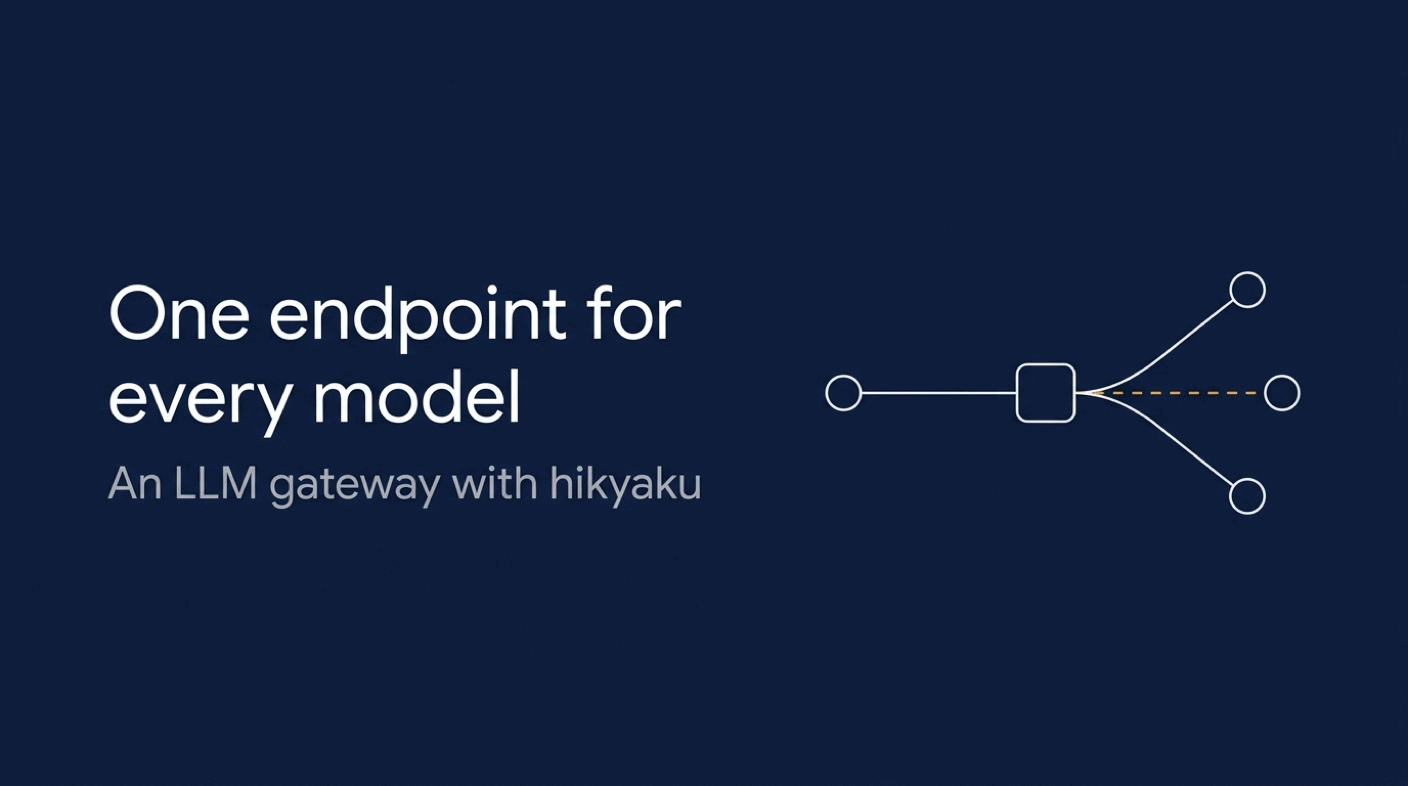
Most apps hard-code one model from one provider. The day that provider is slow, down or too expensive, you change code. hikyaku, the open-source Go message relay, can sit in front of all your models as one OpenAI-compatible endpoint. This guide builds a gateway over Gemini, Claude and OpenAI: clients ask for fast, smart or auto, a decision model picks the model for auto in about 150 ms, streaming and function calling pass through, and a failed provider falls back to the next one.
in Go on Go, Golang, Hikyaku, Ai, Webhooks, Messaging, Genkit
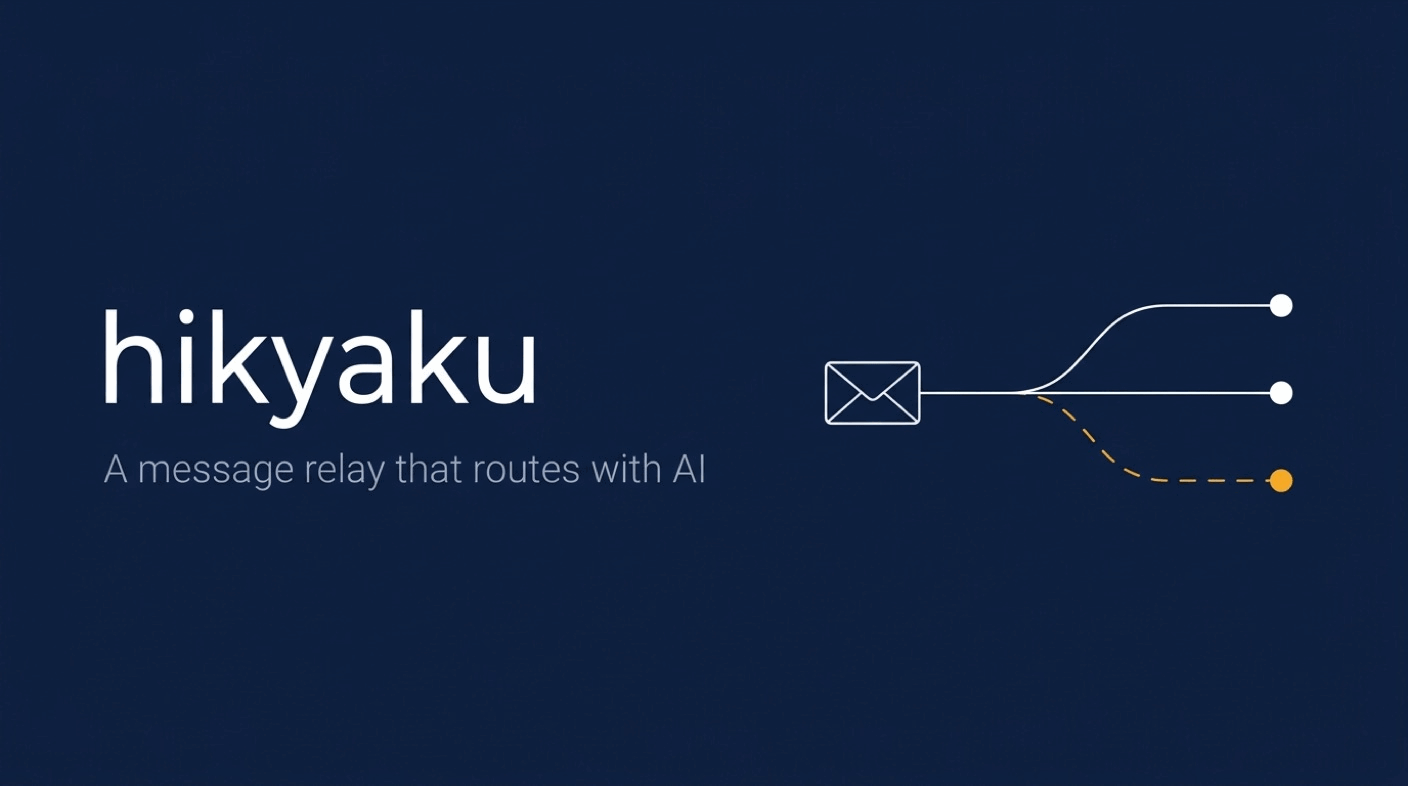
hikyaku is a new open-source message relay written in Go. It reads messages from endpoints (a webhook, a WebSocket, Kafka, SQS and more) and delivers them to others, and one YAML file describes the whole relay. Every step retries and falls back, and what still fails goes to a dead-letter queue you can replay. An AI router picks the destination of each message with a decision model that says how sure it is. This guide builds a support intake relay with AI triage, breaks it on purpose, tests it for CI, and then turns hikyaku into an LLM proxy.
in Go on Go, Golang, Tamesu, Testing, Ai, Browser, E2e
tamesu is an open-source Go CLI that tests a web app the way a person uses it. You write a goal in plain language, a browser agent drives Chromium until the goal is met, and the plan is cached so the next run needs no model calls for it. This guide builds a real suite for a small shop: a checkout flow, a wrong password, a backend that is down, an accessibility audit and a visual baseline, all in one YAML file and ready for CI.
A practical guide to taking a voice AI agent from a laptop demo to a phone agent that answers real calls. You build an AI receptionist on LiveKit Agents: real-time infrastructure, STT, LLM and TTS selection, SIP trunks and dispatch rules, tools that call a backend, cold and warm transfers to a human, deployment and monitoring, and a pre-launch test plan with unit tests and real phone calls placed by tamesu.
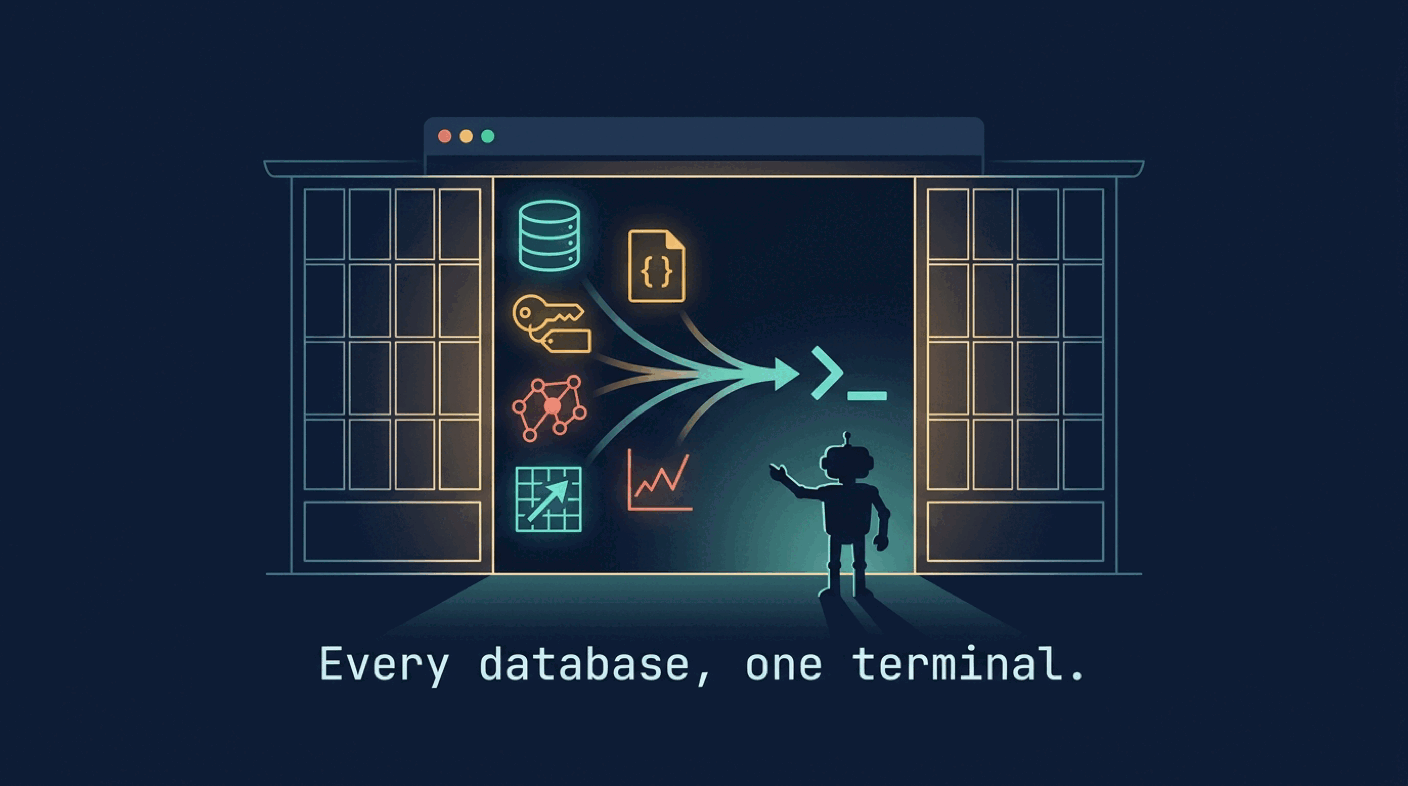
in Go on Go, Golang, Tobira, Databases, Mcp, Ai, Cli
tobira is a new open-source Go CLI and terminal UI that puts one driver contract in front of 31 databases: PostgreSQL, SQLite, MongoDB, Redis, ClickHouse, Qdrant, Neo4j and more. One query command with JSON, CSV and exit codes for scripts, a read-only guard the query text cannot lift, an AI assistant that answers questions by running read-only queries, an MCP server that gives Claude Code and Cursor the connections you choose, and an agent skill that teaches your coding agent the whole CLI.
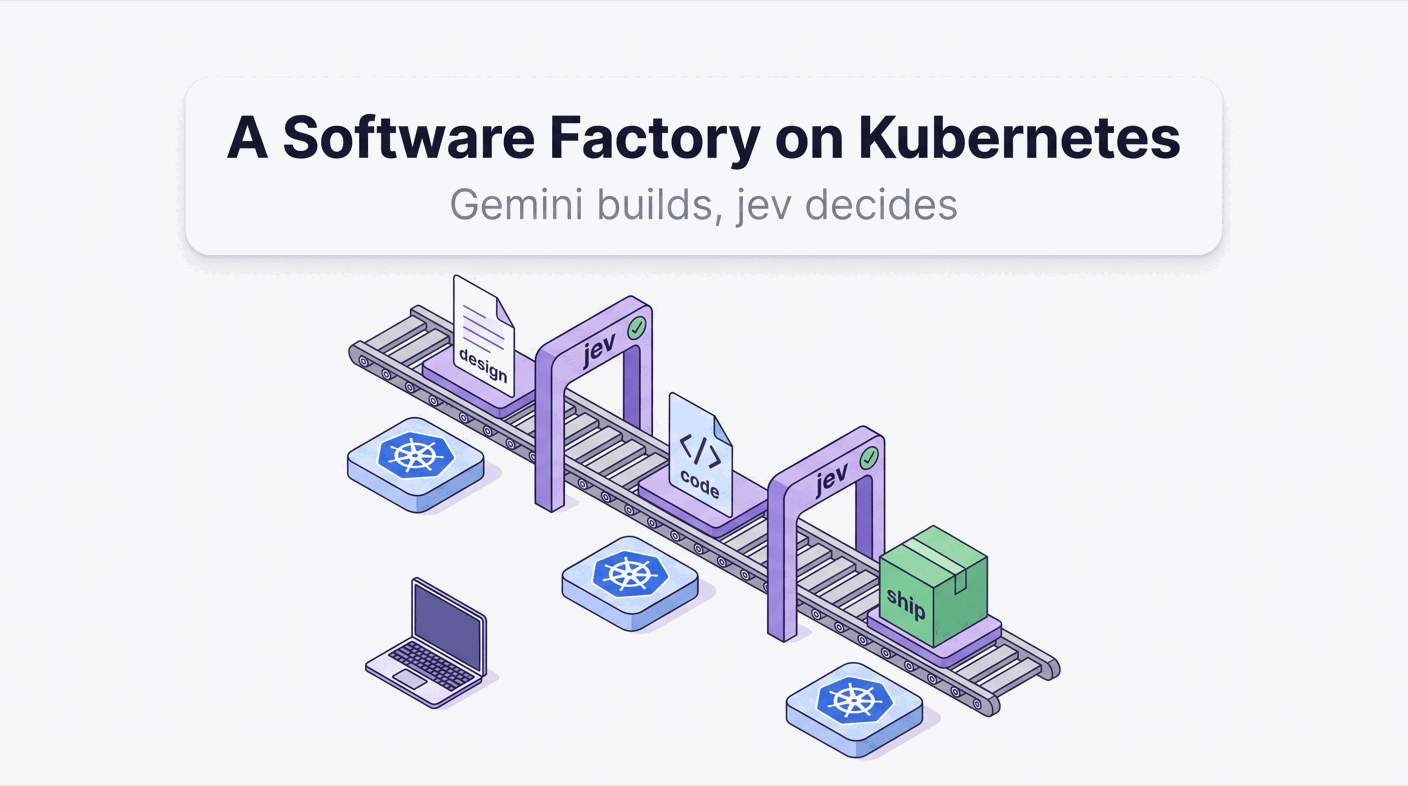
in Genkit on Genkit, Senro, Kubernetes, Golang, Ai, Agents
A feature request goes in; a designed, planned, implemented, tested and reviewed Go module comes out, or a brief for a human explaining why the factory stopped. Every stage is a Genkit flow running as a pod through senro, Gemini does the writing, and jev, a decision model, holds every gate: is the design ready, should the code ship, go back, or stop. A practical guide with a local kind cluster and every output pasted from a real run.
in Genkit on Genkit, Senro, Kubernetes, Golang, Ai, PipelinesLast modified at:
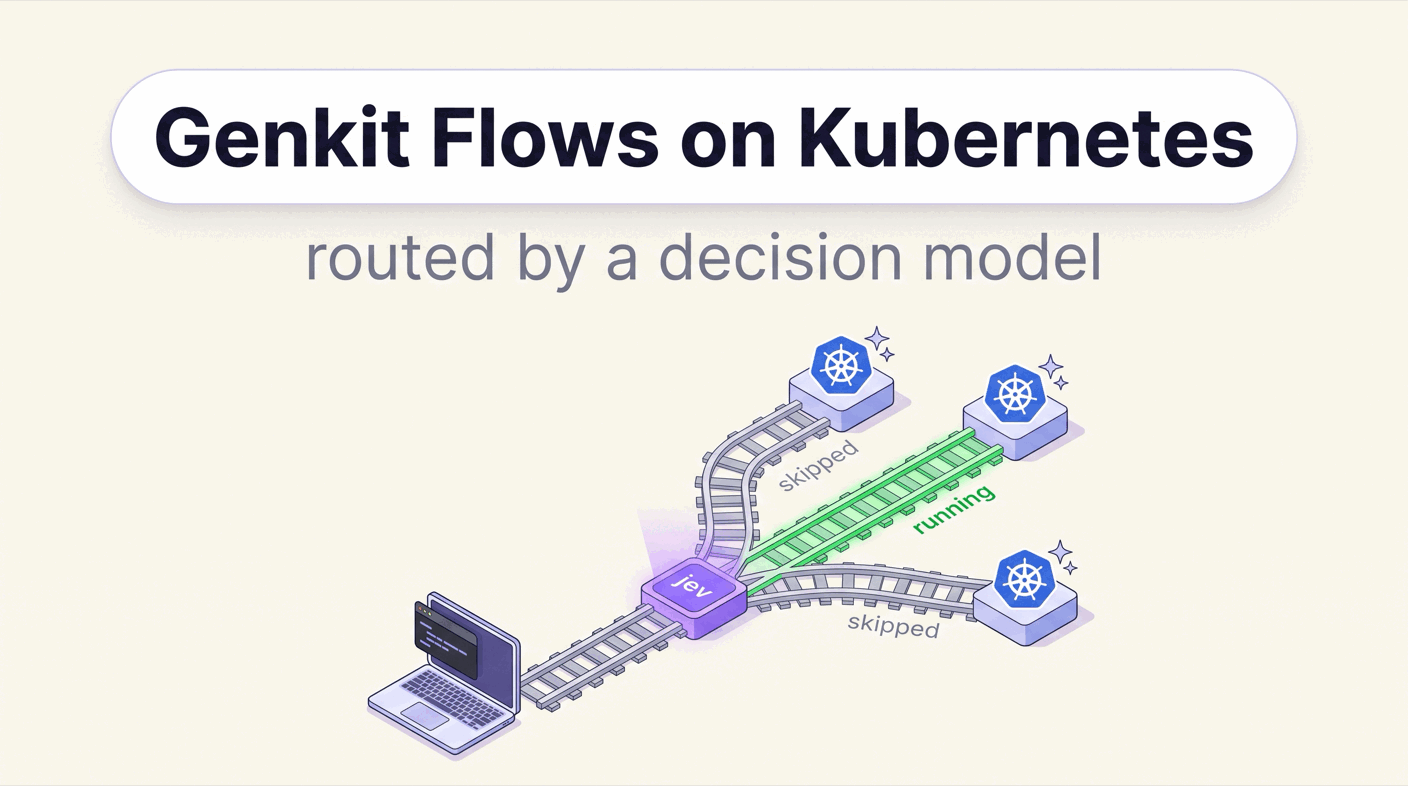
Run every step of an AI pipeline as a Genkit flow inside a Kubernetes pod, and let jev, a decision model reached through Genkit’s System One plugin, decide which steps run next. Gemini writes, jev decides, senro runs the pods. A practical guide with a local kind cluster and every output pasted from a real run.
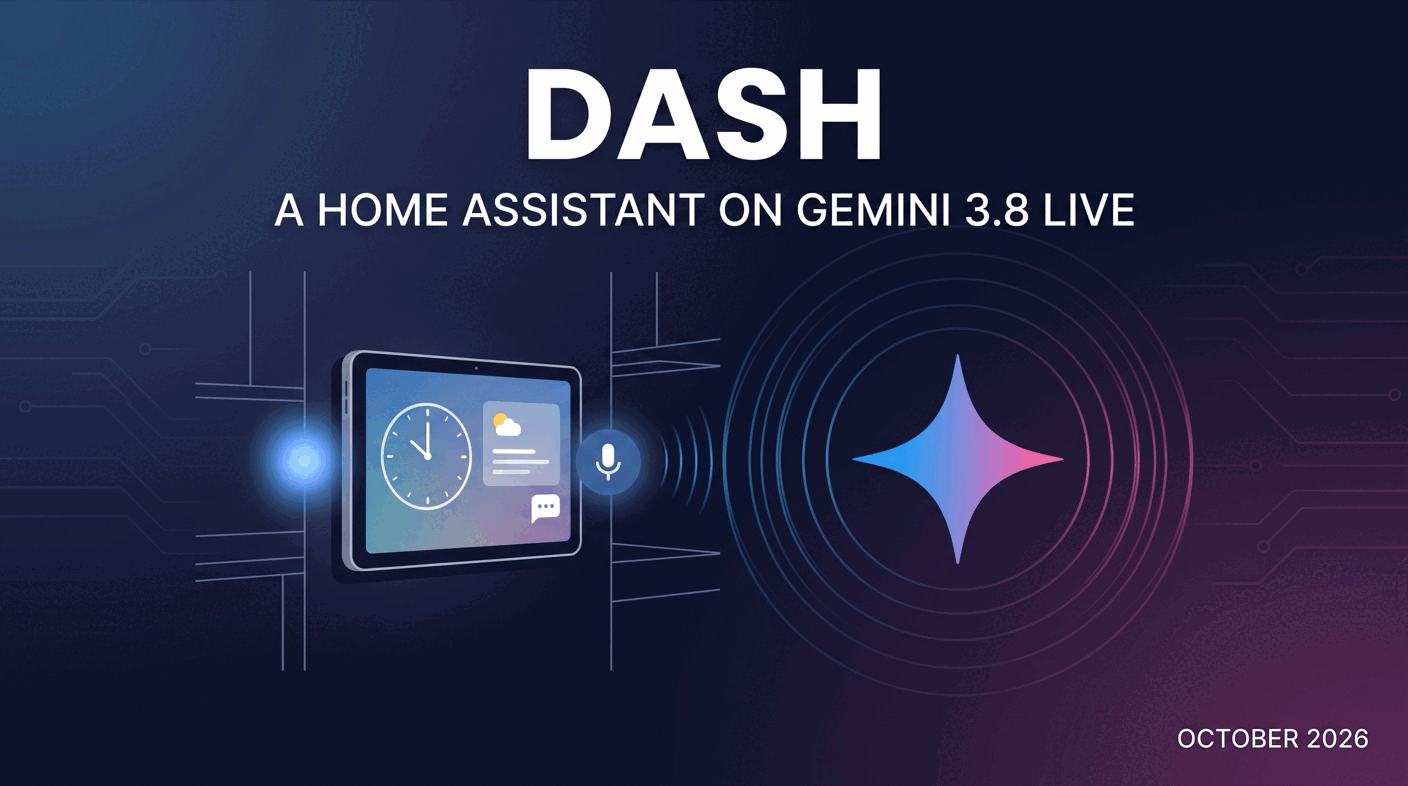
Dash is my open-source ambient display for a wall tablet, in the spirit of a Nest Hub, with a “Hey Dash” voice assistant on top. This article is about that assistant: how the Gemini Live API works under the hood (ephemeral tokens, the WebSocket protocol, PCM audio, tool calls, Google Search grounding), what Gemini 3.8 Live changes, what it costs per question, and the design decisions that keep the API key on the server and the microphone off Gemini until you say the wake word.
in Genkit on Genkit, Golang, ComparisonLast modified at:
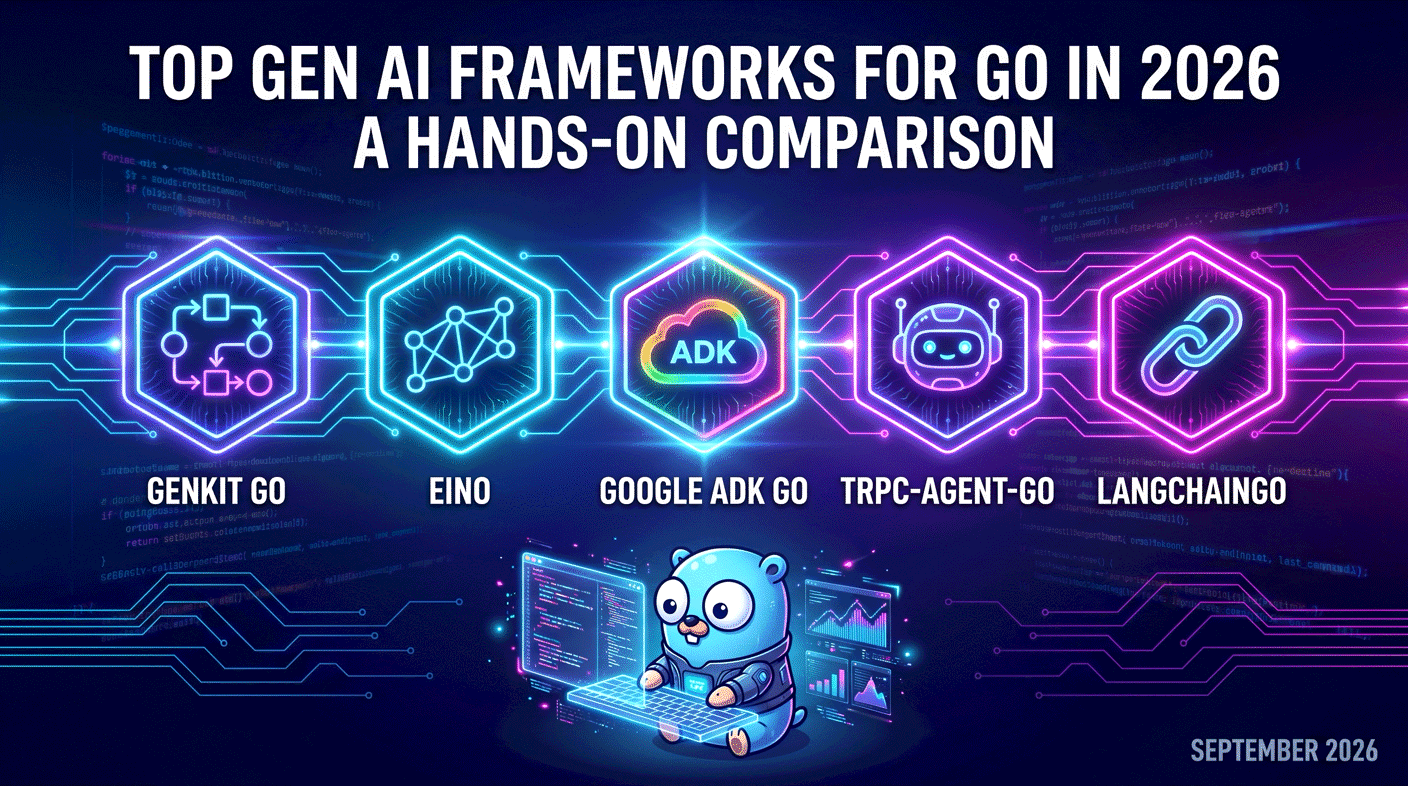
A practical, in-depth comparison of the top Generative AI frameworks for Go in 2026: Genkit Go, Eino, Google ADK Go, tRPC-Agent-Go, and LangChainGo, with real code and real output for each one (English)
in Go on Go, Golang, Senro, Monorepo, Ci-cd, Caching
A practical guide to the parts of senro you use every day: checking code out into a workspace, caching a step so it never runs twice, fanning one step out over every module in a monorepo, narrowing that fan-out to only what a change affects, and letting the pipeline binary decide for itself whether a webhook is its business.
in Go on Go, Golang, Senro, Ci-cd, Pipelines, DevopsLast modified at:
CI systems ask you to describe real programming (dependency graphs, retries, branching, recovery) in YAML, a language with no functions, no types, no tests and no debugger. senro is a new open-source pipeline engine that starts from the other end: the pipeline is the Go program. It builds an immutable plan, runs it locally, in containers, on Kubernetes or over SSH, and exposes one event stream you can attach to live.
in Go on Go, Golang, Senro, Debugging, Ci-cd, Observability
Debugging a CI failure usually means adding a print statement and pushing again. senro records every run as an append-only event stream you can replay with the same client that watched it live, lets you open a shell inside a step while it is still running, explains cache misses component by component, and will re-execute a step to check whether it lied about being pure. This is the field guide, in the order you should use it.
in Genkit on Genkit, Langchaingo, Golang, Comparison
A practical comparison of the two main Go AI frameworks, built around the same production service written twice: RAG, tool calling, typed output, retries, cross-vendor fallback and tracing. 73 lines in Genkit Go against 272 in LangChainGo.
in Genkit on Genkit, Langchaingo, Golang, MigrationLast modified at:
A complete, step-by-step migration guide. Every LangChainGo concept mapped to its Genkit Go equivalent, with before and after code for models, prompts, chains, structured output, tools, agents, RAG and memory.
A Genkit flow is a great unit of AI work and a poor unit of orchestration. senro is a pipeline engine where every step already has retries, caching, an event stream and live attach. Put a flow inside a step and each model call becomes a graph node: change one document out of three and you pay for one call, not three. A practical guide, with every example running against the real Gemini API.
in Genkit on Genkit, Adk, Golang, AgentsLast modified at:
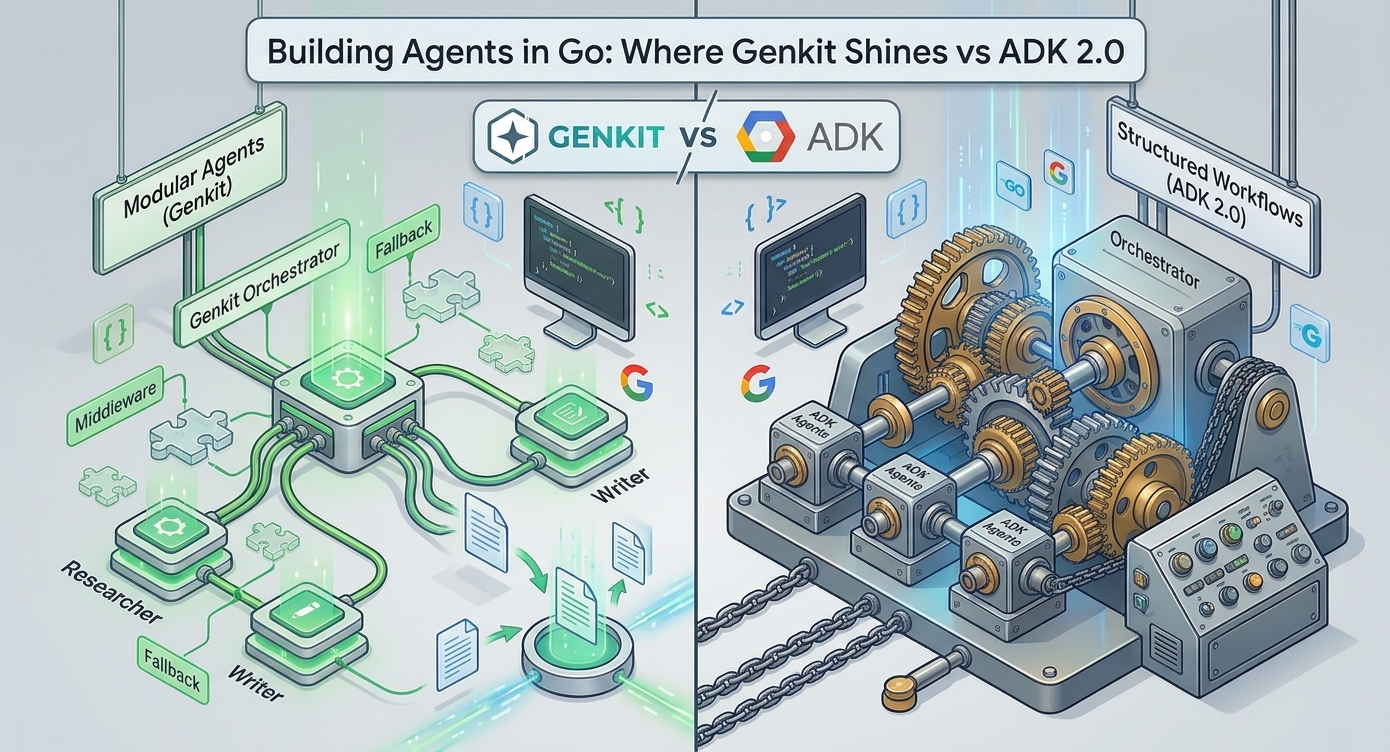
A companion to my Genkit Go vs ADK Go 2.0 comparison, this time only about agents. I built a fire-and-forget research team in 90 lines of Genkit: an orchestrator with two sub-agents, artifacts, cross-vendor model fallback and human approval, then tried to build the same thing in ADK. Middleware and the plugin ecosystem are what make the difference, and every program in this article ran.
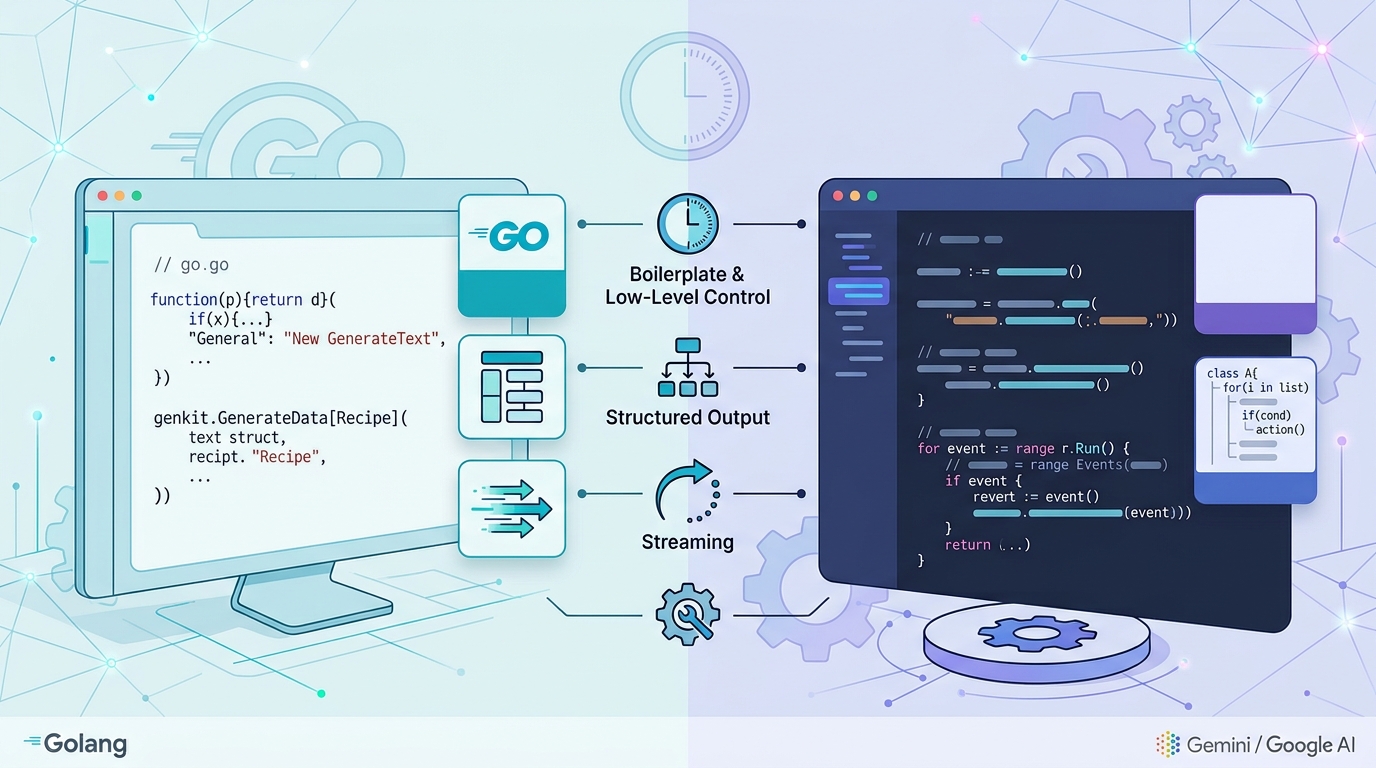
I built the same eight programs twice, once with Genkit Go and once with Google’s ADK Go 2.0, and ran them all against Gemini: hello world, structured output, streaming, tools, middleware, custom models, multi-turn and HTTP serving. This is what the code actually looks like in each, where ADK makes you pay an “agent tax”, where Genkit lets you drop lower, and where ADK’s ceremony genuinely pays off.
in Kubernetes on Kubernetes, Go, Golang, Mamori, Secrets, Configmap, Secret-rotation
You updated a Kubernetes Secret and then did the ritual: kubectl rollout restart. There is a better way. mamori watches your Secrets and ConfigMaps with native informers and reconciles the change into your running Go process, atomically and validated, without bouncing a single pod.
Pagination
Templates (for web app):
Keep going!Keep going ×2!Give me more!Thank you, thank youFar too kind!Never gonna give me up?Never gonna let me down?Turn around and desert me!You're an addict!Son of a clapper!No wayGo back to work!This is getting out of handUnbelievablePREPOSTEROUSI N S A N I T YFEED ME A STRAY CAT