Azure Key Vault Secrets That Reconcile Themselves in Go, with mamori (English)
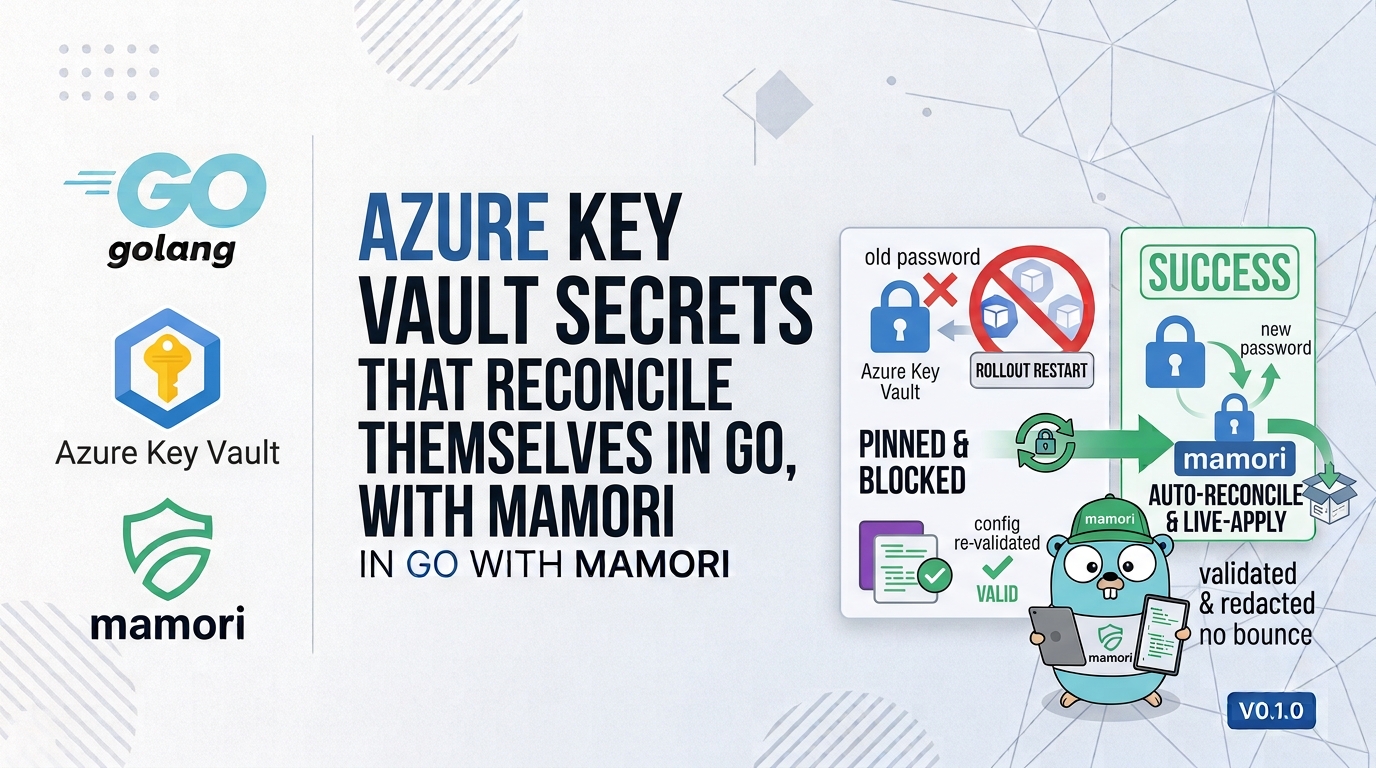
Azure Key Vault versions your secrets and lets you rotate them behind the scenes, but your Go service resolved the secret once at boot and never looked again. mamori watches Key Vault and reconciles a new version into your running process, typed, validated, and redacted, without a restart.
- Introduction
- The
azure-kvscheme - Setup
- Load, then watch the rotation
- What reconciliation guarantees
- Structured secrets with
flatten - When you don’t need this
- Wrapping up
Introduction
Azure Key Vault is the well-behaved citizen of the Azure secrets world. Every secret is versioned, you get soft-delete and purge protection, access is governed by RBAC or access policies, and DefaultAzureCredential means your app authenticates the same way locally (az login) and in production (Managed Identity / Workload Identity on AKS) with zero code changes.
And yet the same old gap is there. Your Go service calls GetSecret once at startup, decodes the value into a struct, and treats it as immutable for the life of the process. When someone rotates the secret in Key Vault — a new version, the old one disabled — your service has no idea. It keeps using the value it read at boot until the next deploy or pod restart. The rotation was seamless in Azure and invisible to your app, which is exactly the wrong combination.
mamori is a Go library I built to fix this class of problem across every backend. Point it at a Key Vault secret and it watches for new versions, pulls the change, re-validates your whole config, and swaps it in atomically — while your service keeps running.
This is the Azure entry in the mamori launch series. For the full model, start with Introducing mamori: Typed, Watchable Config & Secrets for Go; here we focus on Key Vault.
The azure-kv scheme
The providers/azure module registers the azure-kv scheme. The grammar is azure-kv://<vault-name>/<secret-name>[#json-key][?version=<v>]:
azure-kv://my-vault/db-password              # latest enabled version
azure-kv://my-vault/api-key?version=abc123   # pin to a specific version id
azure-kv://my-vault/creds#password           # one key out of a JSON secret
One Key Vault quirk to keep in mind: versions are identified by opaque hex ids, not the sequential 1, 2, 3 you get in GCP Secret Manager. So ?version= here pins to an id like abc123def456..., not a number. Leave ?version off and mamori tracks whatever the latest enabled version resolves to — which is what you want for credentials that rotate.
Setup
go get github.com/xavidop/mamori
go get github.com/xavidop/mamori/providers/azure
Register it with a blank import. It authenticates through DefaultAzureCredential, so it picks up your az login locally, a Managed Identity on a VM/App Service, or Workload Identity on AKS — automatically, in that order:
import _ "github.com/xavidop/mamori/providers/azure"
The identity you bind needs read access to the vault’s secrets. With Key Vault’s RBAC model that’s the built-in Key Vault Secrets User role, scoped to the vault (or to individual secrets):
az role assignment create \
  --role "Key Vault Secrets User" \
  --assignee "<managed-identity-object-id>" \
  --scope "/subscriptions/<sub>/resourceGroups/<rg>/providers/Microsoft.KeyVault/vaults/my-vault"
If your vault still uses the classic access-policy model instead of RBAC, grant Get (and List) on secrets.
Load, then watch the rotation
package main

import (
	"context"
	"log"
	"time"

	"github.com/xavidop/mamori"
	"github.com/xavidop/mamori/secret"

	_ "github.com/xavidop/mamori/providers/azure"
)

type Config struct {
	// Tracks the latest enabled version: rotations flow in automatically.
	DBPassword secret.String `source:"azure-kv://my-vault/db-password"`

	// Pinned to an immutable version id: deliberate, reproducible.
	SigningKey secret.String `source:"azure-kv://my-vault/signing-key?version=abc123"`

	// One field out of a JSON secret.
	APIToken secret.String `source:"azure-kv://my-vault/creds#api_token"`
}

func main() {
	ctx := context.Background()

	w, err := mamori.Watch[Config](ctx,
		mamori.WithPollInterval(60*time.Second),
		mamori.OnChange(func(ev mamori.Change[Config]) {
			if ev.Changed("DBPassword") {
				pool.Rotate(ev.New.DBPassword.Reveal()) // live, no restart
				log.Println("Key Vault: db-password rotated and applied")
			}
		}),
		mamori.OnError(func(err error) { metrics.Inc("config_error") }),
	)
	if err != nil {
		log.Fatal(err)
	}
	defer w.Close()

	cfg := w.Get() // last VALID config, lock-free
	_ = cfg
}
Every secret field is a secret.String, so it redacts itself in fmt, slog, and JSON — a stray log.Printf("%+v", cfg) prints [REDACTED] — and only reveals plaintext through an explicit .Reveal(). mamori also ships a go vet analyzer that fails your build if an azure-kv:// value lands in a plain string instead of a secret.String.
What reconciliation guarantees
When a new version of db-password becomes the latest enabled one, mamori’s poll cycle detects the version change, fetches it, and then:
- Re-validates the entire struct — a value that fails a
validaterule is rejected atomically;Get()keeps returning the last good config andOnErrorreceives a*ValidationError. A bad secret can’t break your service. - Swaps atomically —
w.Get()moves from old to new in one lock-free store; no reader ever sees a half-updated config. - Fires a diff-aware callback —
ev.Fieldstells you exactly which fields moved, so you only rebuild what changed.
Key Vault has no push channel for “a new version was created”, so mamori polls — politely: the interval is jittered by ±20% (tunable with WithJitter) so a fleet of pods doesn’t hammer the vault on the same tick, and change detection compares the version id before pulling the payload, so an unchanged secret is cheap.
If Key Vault is briefly unreachable, mamori retries with backoff and keeps serving the last good value; wire WithStale(10*time.Minute) and check for a *mamori.StaleError in OnError if you want to page only on a prolonged outage rather than a transient blip.
Structured secrets with flatten
Storing a whole connection blob as one JSON secret? Decode it straight into a nested struct:
type Config struct {
	DB DBConfig `source:"azure-kv://my-vault/db-conn" flatten:"json"`
}

type DBConfig struct {
	Host     string        `mapstructure:"host"`
	Port     int           `mapstructure:"port"`
	Password secret.String `mapstructure:"password"`
}
One Key Vault call, one JSON document, cleanly typed — with the password still redacting itself.
When you don’t need this
If a secret only ever changes on deploy, a plain mamori.Load at boot is all you need — no watching, no poll loop. mamori earns its keep the moment a Key Vault secret rotates while your process is running and you’d rather rebuild a client than recycle a pod.
Wrapping up
Azure Key Vault rotates your secrets cleanly; mamori makes your Go service actually notice. It watches Key Vault, reconciles a new version into your running process — typed, validated, redacted — and lets you pin the versions you want frozen.
go get github.com/xavidop/mamori/providers/azure
- Full introduction: Introducing mamori
- Docs: mamorigo.dev/docs
- Source: github.com/xavidop/mamori
mamori is MIT-licensed and at v0.1.0 — early and moving fast, so issues and feedback are very welcome. Happy coding!