Introducing mamori: Typed, Watchable Config & Secrets for Go (English)
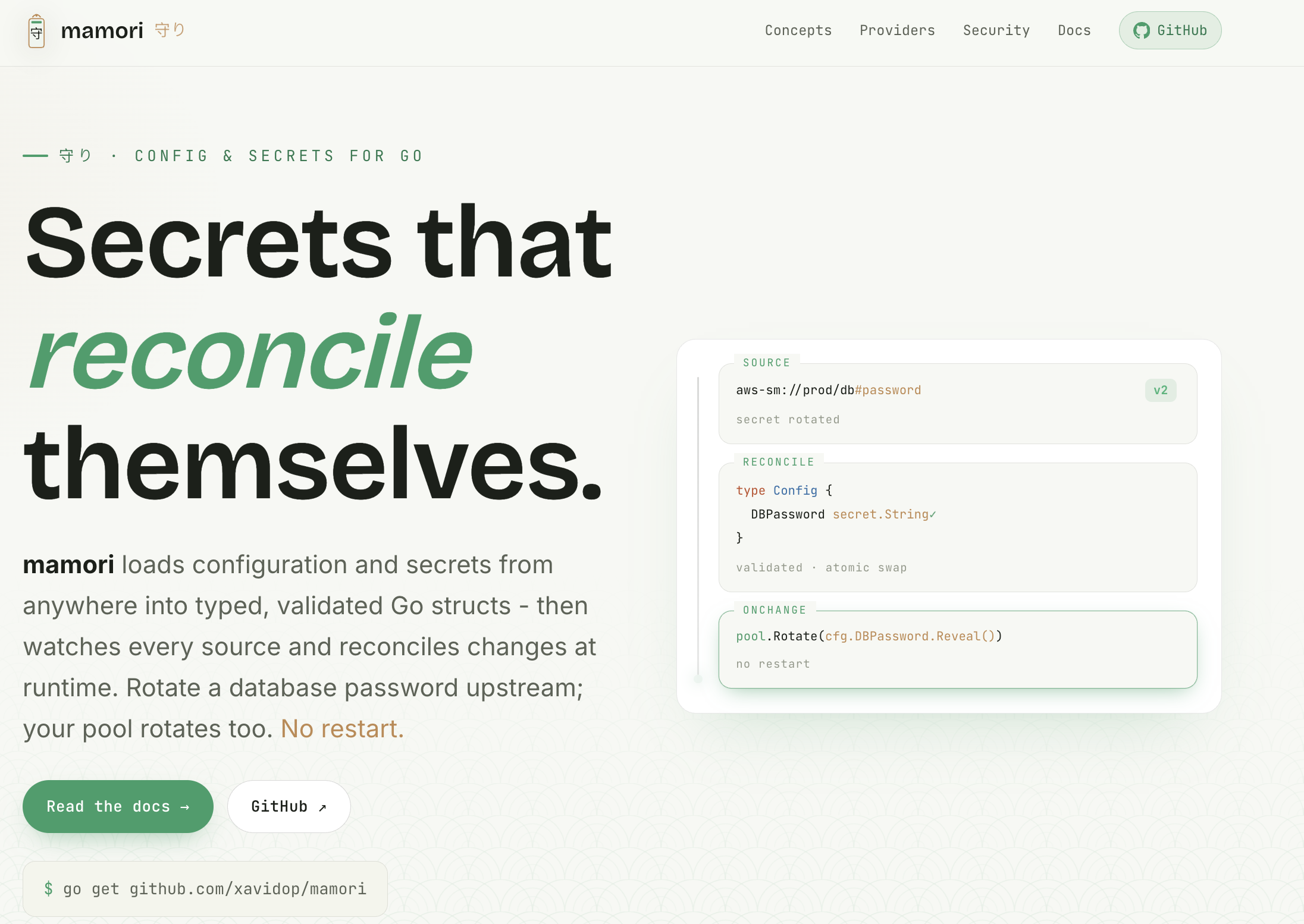
Every Go service ends up hand-rolling the same thing: a config loader, a secrets fetcher, a ticker to refresh them, a mutex, and a prayer that nothing leaks into the logs. mamori is a new open-source Go library that loads configuration and secrets from more than 30 sources into typed, validated structs, and keeps them reconciled at runtime, without a restart.
- Introduction
- The restart-to-rotate problem
- What is mamori?
- How mamori compares
- Getting started
- Watching and reconciliation
- Secrets that behave like secrets
- Providers: more than 30 sources
- Writing your own provider
- Middleware: cache, failover, audit, rate-limit
- Observability out of the box
- A complete, runnable example
- When to reach for mamori (and when not)
- Wrapping up
Introduction
Every Go service I have ever shipped ends up growing the same organ. It starts small: a couple of os.Getenv calls. Then a secret needs to come from AWS Secrets Manager, so you add the SDK. Then someone wants that secret to rotate without a deploy, so you add a time.Ticker. Then the ticker needs a mutex because two goroutines read the config while it is being replaced. Then a bad value slips in and takes down production, so you add validation. Then a secret shows up in a log line during an incident, and now you are adding a redaction wrapper too.
By the end you have a bespoke ConfigManager in every repo: a loader, a fetcher, a refresh loop, a mutex, and a prayer. It is never quite the same twice, it is rarely tested well, and it is exactly the kind of code nobody wants to own.
I got tired of writing it, so I built a library that does it once, properly. It is called mamori, it is open source, and this article is the full tour: what it is, why it exists, how to use it end to end, and when you should (and shouldn’t) reach for it.
The restart-to-rotate problem
Here is the assumption baked into most Go config code: configuration is static. You read it at boot, decode it into a struct, and treat that struct as immutable for the lifetime of the process. If something changes, you redeploy.
That assumption was fine when “config” meant a log level and a port. It is not fine anymore. In a modern service, a meaningful amount of your config is dynamic by nature:
- Database passwords and API tokens rotate on a schedule (and increasingly, automatically).
- Vault hands you dynamic credentials with a lease that expires in an hour.
- Feature flags flip in the middle of the day, on purpose.
- TLS certificates get reissued.
The industry answer to “config is dynamic” has mostly been to push the problem into the platform. On Kubernetes, the External Secrets Operator syncs your cloud secret into a Secret, and then… you still restart the pod to pick it up, or you mount it as a file and hope your app re-reads it. The dynamic part gets flattened back into a static one at the worst possible layer.
mamori takes the opposite position: your process should be able to observe a change at the source and react to it, in memory, without bouncing. Rotating a password should rotate a connection pool, not recycle a pod.
What is mamori?
mamori (守り, Japanese for “protection” or “safeguard”) is an embedded Go library — not an operator, not a server, not a sidecar. It lives inside your process. Its tagline says it plainly:
Typed, watchable config & secrets for Go. Load configuration and secrets from anywhere into validated Go structs — and keep them reconciled at runtime, without a restart.
There are three concepts you actually touch, and they map cleanly onto three types:
Refs. Struct fields carry a
sourcetag containing a URL-like reference to where the value lives —env:LOG_LEVEL,aws-sm://prod/db#password,vault://secret/app#token. A ref names what you want, not how to fetch it.Providers. A provider resolves one scheme (
aws-sm,vault,k8s-secret, …) into a value. Providers register themselves using the same pattern asdatabase/sqldrivers, so the core module carries zero cloud-SDK dependencies — you only pull in the providers you use.The Reconciler. This is the interesting part.
Watchresolves every ref once (fail-fast at startup), then keeps watching each source. When a value changes, it re-validates the entire struct, and only if the new snapshot is valid does it atomically swap it in and hand you a diff-aware callback. Your app never sees a half-updated, invalid config.
If you have used IOptionsMonitor<T> in .NET, w.Get() is the direct analogue: always the latest valid configuration, lock-free.
How mamori compares
I want to be honest about prior art, because none of these primitives are new — mamori’s contribution is composing them.
gocloud.dev/runtimevaris the closest primitive. It watches a single variable beautifully, but it is one variable at a time, with no struct composition, no tags, no validation, no secret hygiene. mamori adds all of that on top of the same idea.- Viper / koanf are excellent, but they are config-first with secrets bolted on. mamori is deliberately secrets-first, with config included: secret types redact by default, and there is a
go vetanalyzer that yells at you if you store a secret in a plainstring. - envconfig / caarlos0/env are load-once. No watching, env only.
- The External Secrets Operator is complementary, not competitive. mamori is for apps that want to skip the Kubernetes
Secrethop entirely, or that do not run on Kubernetes at all. It keeps no persistent external state, so there is no finalizer lifecycle to babysit.
And to be equally clear about what mamori is not: it is not a secrets store (no encryption at rest, no server), not a sync engine between stores, not a general feature-flag platform, and not cross-language. It is a Go-idiomatic library and it stays in its lane.
Getting started
The core module has built-in env:, file://, and dotenv: providers, so you can do something useful with zero extra dependencies:
go get github.com/xavidop/mamori
Heads up: mamori requires Go 1.26 or newer. It leans on modern generics ergonomics, so this is a hard floor, not a suggestion.
The whole API is driven by a struct and its tags. You describe what you want; mamori figures out how:
package main

import (
	"context"
	"log"

	"github.com/xavidop/mamori"
	"github.com/xavidop/mamori/secret"
)

type Config struct {
	DBPassword secret.String `source:"aws-sm://prod/db#password"`
	LogLevel   string        `source:"env:LOG_LEVEL" default:"info" validate:"oneof=debug info warn error"`
	Workers    int           `source:"env:WORKERS" default:"4" validate:"gte=1,lte=256"`
	TLSCert    []byte        `source:"file:///etc/tls/tls.crt"`
}

func main() {
	cfg, err := mamori.Load[Config](context.Background())
	if err != nil {
		log.Fatal(err)
	}
	// cfg is fully resolved, defaulted, and validated.
}
The signature is exactly what you’d hope for:
func Load[T any](ctx context.Context, opts ...Option) (T, error)
Load resolves every ref once, applies defaults, validates, and returns your typed config. It fails fast: on any resolve or validation error it returns the zero value and a non-nil error. It never returns a partially-populated struct — you either get a complete, valid config or an error.
A few things worth knowing about the tags:
| Tag | Meaning |
|---|---|
source:"..." | The ref: where the value comes from. |
default:"..." | Used only when the ref resolves to not-found — never on an error. |
validate:"..." | go-playground/validator/v10 syntax, run on load and on every update. |
flatten:"json\|yaml\|env" | Decode one payload into a nested struct. |
optional:"true" | Tolerate not-found with no default (field keeps its zero value). |
That default-only-on-not-found rule is deliberate and important: if AWS Secrets Manager is having a bad day, you want an error, not a silent fallback to a default password.
Watching and reconciliation
This is why mamori exists. Swap Load for Watch and your config becomes a living thing:
func Watch[T any](ctx context.Context, opts ...Option) (*Watcher[T], error)
You read the current config with a lock-free w.Get(), and you react to changes with an OnChange callback:
w, err := mamori.Watch[Config](ctx,
	mamori.WithPollInterval(30*time.Second),
	mamori.OnChange(func(ev mamori.Change[Config]) {
		if ev.Changed("DBPassword") {
			pool.Rotate(ev.New.DBPassword.Reveal())
		}
		for _, f := range ev.Fields {
			log.Printf("%s changed: %s -> %s", f.Path, f.OldVersion, f.NewVersion)
		}
	}),
	mamori.OnError(func(err error) { metrics.Inc("config_error") }),
)
if err != nil {
	log.Fatal(err)
}
defer w.Close()

cfg := w.Get() // always the last VALID config, no lock needed
The Change[T] you get in the callback carries the old value, the new value, and a per-field diff, plus a Changed(path) helper so you only do expensive work (like rebuilding a connection pool) when the field you care about actually moved.
The guarantees are the whole point, so let me spell them out:
- Atomicity.
OnChangeonly ever fires with a fully re-validated snapshot. If an incoming value fails validation, the update is rejected:Get()keeps returning the last good config andOnErrorreceives a*ValidationError. Your config never transitions into a broken state mid-flight. - Push where possible, poll where not. Providers whose backend can push changes (Kubernetes informers, Vault lease watchers, Consul blocking queries,
fsnotifyfor files) push natively. Everything else is polled onWithPollInterval, jittered by ±20% by default so a fleet of pods doesn’t stampede your secrets backend on the same tick. If a native watch fails to start, mamori quietly falls back to polling. - Coalescing. Rapid-fire changes within a debounce window (500ms default, overridable per-field with
?debounce=) collapse into a single event. - Lease-aware. If a provider reports an expiry (Vault dynamic creds), mamori schedules a refresh before the lease dies, rather than waiting for the next poll.
- First event.
Watchresolves the initial config before it returns, soOnChangefires only on subsequent changes. Read the initial state fromw.Get().
There’s a nice operational escape hatch too. Transient backend outages shouldn’t page anyone — but prolonged staleness should. WithStale draws that line for you:
w, err := mamori.Watch[Config](ctx,
	mamori.WithStale(10*time.Minute),
	mamori.OnError(func(err error) {
		var stale *mamori.StaleError
		if errors.As(err, &stale) {
			alert.Page("config stale", stale)
			return
		}
		metrics.Inc("config_transient_error")
	}),
)
A blip retries with exponential backoff and keeps the last good value. Ten minutes of failure escalates to a hard *StaleError you can actually page on.
Secrets that behave like secrets
Configuration and secrets are treated differently, on purpose. Any field that holds a secret should be a secret.String or secret.Bytes instead of a plain string or []byte. These types redact themselves everywhere a value normally leaks:
s := secret.NewString("hunter2")

fmt.Println(s)              // [REDACTED]
fmt.Sprintf("%v", s)        // [REDACTED]
fmt.Sprintf("%#v", s)       // [REDACTED]
json.Marshal(s)             // "[REDACTED]"
slog.Info("login", "pw", s) // pw=[REDACTED]

s.Reveal()                  // "hunter2"  <- the only way to read the plaintext
It works because the type implements fmt.Stringer, fmt.GoStringer, json.Marshaler, and slog.LogValuer. The single, greppable access point is Reveal(). That is a feature: in code review or an audit, grep Reveal shows you every place a secret is actually unwrapped. (secret.Bytes.Reveal() returns []byte rather than a string, for keys and certificates.)
And because “just remember to use secret.String” is exactly the kind of discipline that erodes under deadline pressure, mamori ships a go vet analyzer that enforces it:
go install github.com/xavidop/mamori/tools/reconcilevet/cmd/reconcilevet@latest
go vet -vettool=$(which reconcilevet) ./...
reconcilevet flags any field whose source points at a secret-bearing scheme (aws-sm, gcp-sm, azure-kv, vault, op, sops, k8s-secret) but is stored in a plain string or []byte. The leak becomes a build failure, not a postmortem.
Providers: more than 30 sources
The core stays dependency-free; each cloud backend is its own module you opt into. A ref’s scheme picks the provider:
go get github.com/xavidop/mamori/providers/aws         # aws-sm://  aws-ps://
go get github.com/xavidop/mamori/providers/vault       # vault://
go get github.com/xavidop/mamori/providers/gcp         # gcp-sm://
go get github.com/xavidop/mamori/providers/azure       # azure-kv://
go get github.com/xavidop/mamori/providers/k8s         # k8s-secret://  k8s-cm://
go get github.com/xavidop/mamori/providers/consul      # consul://
go get github.com/xavidop/mamori/providers/doppler     # doppler://
go get github.com/xavidop/mamori/providers/onepassword # op://
go get github.com/xavidop/mamori/providers/sops        # sops://
That is a small slice. All in, there are more than 30 providers: secret managers (AWS Secrets Manager, AWS Parameter Store, Vault, GCP, Azure Key Vault, Doppler, 1Password, SOPS), databases (Postgres, MySQL, SQLite, MongoDB, DynamoDB, Cosmos DB, Redis), KV stores (Consul, etcd), Kubernetes Secrets and ConfigMaps, Firebase/Firestore/Remote Config, object storage (S3, GCS, Azure Blob), and a whole shelf of feature-flag platforms (LaunchDarkly, Unleash, Flagsmith, ConfigCat, Split, GrowthBook, Flipt, GO Feature Flag).
Registration follows the database/sql convention — a blank import runs the provider’s init(), which calls mamori.Register(...):
import _ "github.com/xavidop/mamori/providers/vault"
When you need explicit configuration (a region, a custom client), construct the provider and pass it with WithProvider. That takes precedence over the registry for that call:
import awsprov "github.com/xavidop/mamori/providers/aws"

cfg, err := mamori.Load[Config](ctx,
	mamori.WithProvider(awsprov.NewSecretsManager(awsprov.WithRegion("eu-west-1"))),
)
The ref grammar is compact — scheme://path[#key][?opts] — with a couple of quirks worth internalizing:
- The
#keyfragment selects one field out of a JSON payload:aws-sm://prod/db#password. - AWS Parameter Store,
etcd,sops, andfilepreserve absolute paths, so they use a triple slash:aws-ps:///myapp/log-level,file:///etc/tls/tls.crt. - Doppler is the one provider where the
#fragment is required:doppler://backend/prd#STRIPE_API_KEY.
When a payload is a structured blob, you can decode it straight into a nested struct with flatten:
type Config struct {
	Redis RedisConfig `source:"aws-sm://prod/redis" flatten:"json"`
}

type RedisConfig struct {
	Addr     string        `mapstructure:"addr"`
	Password secret.String `mapstructure:"password"`
	DB       int           `mapstructure:"db"`
}
One AWS Secrets Manager call, one JSON blob, cleanly typed — with the password still redacting itself.
Writing your own provider
If your source of truth is homegrown — an internal config service, a weird legacy database table — you can teach mamori about it. The interface is intentionally tiny:
type Provider interface {
	Scheme() string
	Resolve(ctx context.Context, ref Ref) (Value, error)
}
A minimal implementation looks like this:
func (p *Provider) Resolve(ctx context.Context, ref mamori.Ref) (mamori.Value, error) {
	raw, err := p.fetch(ctx, ref.Path)
	if isNotFound(err) {
		return mamori.Value{}, mamori.ErrNotFound // MUST satisfy errors.Is
	}
	if err != nil {
		return mamori.Value{}, err
	}
	if ref.Key != "" {
		raw, err = mamori.SelectKey(raw, ref.Key) // implements #key against a JSON payload
		if err != nil {
			return mamori.Value{}, err
		}
	}
	return mamori.Value{
		Bytes:     raw,
		Version:   mamori.VersionHash(raw), // change detection; use a native revision if you have one
		Sensitive: true,                    // true for secret-bearing sources
	}, nil
}

func init() { mamori.Register(New()) } // database/sql pattern; panics on a duplicate scheme
The Version field is what powers cheap change detection: if your backend exposes a revision (a VersionId, a Vault version, an mtime hash), return it; otherwise mamori.VersionHash(bytes) gives you a stable FNV hash for free. Two optional interfaces let you do better when the backend supports it:
type WatchableProvider interface {
	Provider
	Watch(ctx context.Context, ref Ref) (<-chan Update, error)
}

type BatchProvider interface {
	Provider
	ResolveBatch(ctx context.Context, refs []Ref) (map[string]Value, error)
}
Implement Watch only if your backend can genuinely push — otherwise let mamori’s poller do the work, so behavior stays consistent across providers. Implement ResolveBatch if you can fetch many refs in one round trip (the AWS provider does this automatically).
Best of all, you don’t have to trust yourself to get the contract right. There’s a conformance kit — github.com/xavidop/mamori/providertest — that exercises resolution, not-found typing, version monotonicity, concurrency, context cancellation, native watching, goroutine hygiene, and even asserts you never accidentally log the payload. Point it at your provider and it tells you if you’ve broken the rules.
Middleware: cache, failover, audit, rate-limit
Because every provider is just a Provider, you can wrap one in another. The middleware package ships the decorators you’d otherwise reinvent:
| Middleware | What it does |
|---|---|
Cache(ttl, inner) | Memoize successful resolves. Errors and not-found are not cached. |
Failover(primary, replicas...) | Try the primary, fall back to replicas on transport errors. Not-found is authoritative. |
RateLimit(rps, inner) | Cap resolves per second so you don’t trip your secrets backend’s throttle. |
Audit(logger, inner) | Log scheme, ref, latency, and outcome — never the value. |
Prefix(prefix, inner) | Namespace every ref path — handy for multi-tenant setups. |
They compose by nesting, so you can read the stack top-down:
import "github.com/xavidop/mamori/middleware"

mamori.WithProvider(
	middleware.Cache(5*time.Minute,
		middleware.Audit(logger,
			middleware.RateLimit(10,
				middleware.Failover(primarySM, replicaSM),
			),
		),
	),
)
Crucially, the shipped middleware preserves the WatchableProvider and BatchProvider capabilities of whatever they wrap — decorating a provider never silently downgrades it from push to poll.
Observability out of the box
The core takes no OpenTelemetry dependency (keeping it lean), but there’s a bridge module when you want metrics and traces:
go get github.com/xavidop/mamori/x/otel
import (
	"go.opentelemetry.io/otel"
	mamoriotel "github.com/xavidop/mamori/x/otel"
	"github.com/xavidop/mamori"
)

meter, _ := mamoriotel.NewMeter(otel.Meter("mamori"))
tracer := mamoriotel.NewTracer(otel.Tracer("mamori"))

w, err := mamori.Watch[Config](ctx,
	mamori.WithMeter(meter),
	mamori.WithTracer(tracer),
)
You get a mamori.resolve.duration histogram, mamori.refresh.count and mamori.watch.errors counters (all tagged by scheme), and a span per resolve. And because WithMeter/WithTracer take tiny internal interfaces, you can implement them against Prometheus, statsd, or a test recorder without pulling OTel into your binary at all.
A complete, runnable example
Here is the whole loop — load, watch, react — in one file you can run today (it’s the examples/basic program from the repo):
package main

import (
	"context"
	"fmt"
	"log/slog"
	"os"
	"time"

	"github.com/xavidop/mamori"
	"github.com/xavidop/mamori/secret"
)

const tokenPath = "/tmp/mamori-example-token"

type Config struct {
	LogLevel string        `source:"env:LOG_LEVEL" default:"info" validate:"oneof=debug info warn error"`
	Workers  int           `source:"env:WORKERS" default:"4" validate:"gte=1,lte=256"`
	APIToken secret.String `source:"file:///tmp/mamori-example-token"`
}

func main() {
	logger := slog.New(slog.NewTextHandler(os.Stdout, nil))
	_ = os.WriteFile(tokenPath, []byte("initial-token"), 0o600)
	defer func() { _ = os.Remove(tokenPath) }()

	ctx, cancel := context.WithCancel(context.Background())
	defer cancel()

	w, err := mamori.Watch[Config](ctx,
		mamori.WithPollInterval(2*time.Second),
		mamori.OnChange(func(ev mamori.Change[Config]) {
			for _, f := range ev.Fields {
				logger.Info("config changed", "field", f.Path, "from", f.OldVersion, "to", f.NewVersion)
			}
			if ev.Changed("APIToken") {
				logger.Info("rotating clients with the new API token", "token", ev.New.APIToken)
			}
		}),
		mamori.OnError(func(err error) { logger.Warn("reconcile error", "err", err) }),
	)
	if err != nil {
		logger.Error("watch failed", "err", err)
		os.Exit(1)
	}
	defer func() { _ = w.Close() }()

	cfg := w.Get()
	logger.Info("loaded config", "logLevel", cfg.LogLevel, "workers", cfg.Workers, "apiToken", cfg.APIToken)

	// Simulate a rotation a few seconds in.
	go func() {
		time.Sleep(3 * time.Second)
		_ = os.WriteFile(tokenPath, []byte("rotated-token"), 0o600)
	}()

	time.Sleep(8 * time.Second)
	logger.Info("final config", "apiToken", w.Get().APIToken)
}
LOG_LEVEL=debug WORKERS=8 go run ./examples/basic
Notice the token field in the log output: it prints [REDACTED] every time, even though the program is actively rotating it. That’s the whole philosophy in one demo — live rotation, no restart, and nothing leaks.
When to reach for mamori (and when not)
Reach for it when:
- Your config or secrets genuinely change while the process runs, and you want to react in memory instead of bouncing pods.
- You pull from more than one source and are tired of a different SDK and refresh strategy for each.
- Secret hygiene matters and you want redaction and a
go vetguardrail for free. - You run outside Kubernetes, or you’re on Kubernetes but want to skip the
Secret-sync hop.
Probably skip it when:
- Your config is a log level and a port from the environment, read once at boot.
os.Getenvis fine — don’t add a dependency. - You need a secrets store (encryption at rest, a server component) — that’s Vault’s job, not mamori’s.
- You’re syncing secrets between stores — that’s what ESO,
vals, andtellerare for.
Wrapping up
mamori is the library I wish I’d had every time I typed type ConfigManager struct for the fifth time. It takes the boring, error-prone, security-sensitive plumbing — load, validate, watch, redact, reconcile — and makes it a typed struct and one function call.
It’s open source under the MIT license and currently at v0.1.0 — early, pre-1.0, and moving fast, so feedback and issues are genuinely welcome. Give it a spin:
go get github.com/xavidop/mamori
- Docs: mamorigo.dev/docs
- Homepage: mamorigo.dev
- Source: github.com/xavidop/mamori
Provider deep-dives
If you live on a particular platform, I’ve written focused, hands-on companions:
- Hot-reloading Kubernetes Secrets and ConfigMaps in Go — no pod restarts
- Rotating AWS Secrets Manager secrets without restarting your Go service
- GCP Secret Manager, live-reloaded in Go
- Azure Key Vault secrets that reconcile themselves in Go
If you build something with it, or write a provider for a backend I haven’t covered yet, I’d love to hear about it. Happy coding!